

The Camargue France’s Bull-Running Traditions: What Visitors Should Know

Camargue France is famous for wild wet places, white horses, and long bull-running customs. When people visit, they often feel like they step into everyday local life. These events have been shaped over many years, so you see ranch workers, riders, and people from nearby villages all around.
In the Camargue, the bull traditions do not sit apart from ranch life. They show up during village celebrations and in the way the land looks and feels, shaped by wetlands. If you learn the basic local rules and manners first, you can join in more respectfully. You can also stay safer while you watch and take part in the day.
Key Takeaways
- An abrivado brings bulls into or through a village under the direction of mounted guardians.
- A bandido generally refers to the return journey toward pasture or the manade.
- A ferrade is a ranch ceremony to identify and brand young bulls.
- Course camarguaise is a non-lethal arena sport centered on the raseteurs’ skill and the bull’s character.
- Visitors should follow barriers, local instructions, and photography etiquette at every event.
Understanding the Camargue bull-running tradition
In the Camargue, bull running is tied to the countryside way of life. The area is shaped by marsh land, open grass fields, working horses, and small village routines. This is not just one show. It is a set of everyday practices linked to how people raise, train, and manage Camargue bulls.
If you watch closely, you can see more than the crowd and the noise. The events also show how the animals are handled as part of work. Many visitors find it helps to treat it like a living tradition, not only a public party.
The land itself adds meaning. The marshes and wet ground are not just scenery. They explain why the whole practice fits the place. For that reason, a stop at a parc attraction camargue or time near the Camargue wetlands can help you get the background before a festival.
How Camargue events differ from Spanish bullfighting
Camargue events should not be treated as a French version of a Spanish corrida. In an abrivado or bandido, the focus is on moving a group of bulls along a route, usually with mounted guardians guiding and containing them. In course camarguaise, the bull is not killed; raseteurs attempt to remove small objects from between its horns. The pace can still be intense, but the customs, objectives, and relationship with the animal are different.
The role of bulls, guardians, and manades
A manade is a kind of ranch. It is tied to Camargue bulls and horses. People who run it are often called gardians, especially in French. These workers usually stay on horseback. They help during everyday ranch tasks. They also show up for public events. You see them move with the animals and keep things under control.
They know each bull as an individual. They also read the ground and the way the herd shifts. That helps them keep the group together. If you are a traveler, it helps to look at the whole scene. Think of the people, the animals, and the land as one linked setup. Do not treat the bull like the only thing that matters.
Why these traditions remain central to local identity
Festivals let village life slow down for a bit. People can meet their neighbors and follow customs that families have kept for years. Local groups also help hold these events together.
There is another side too. Ranching culture still shows up, even as more of the year gets shaped by tourists. Seasonal visitors come through, and the festival is one way that the old routines stay seen. Many locals feel proud of their region. Still, the events are not made only for outsiders. A good visitor pays attention first. If it feels right, they ask a question. Then they let residents share the parts that are hard to guess.
Abrivado and bandido: The best-known bull-running events
Abrivado and bandido are among the most recognizable public expressions of Camargue ranch culture. The route may pass through open ground, a village edge, or streets temporarily prepared for the occasion. Spectators often stand close to the action, which creates excitement but also demands attention. Check the local program rather than assuming that every town uses the same route or schedule.
What happens during an abrivado
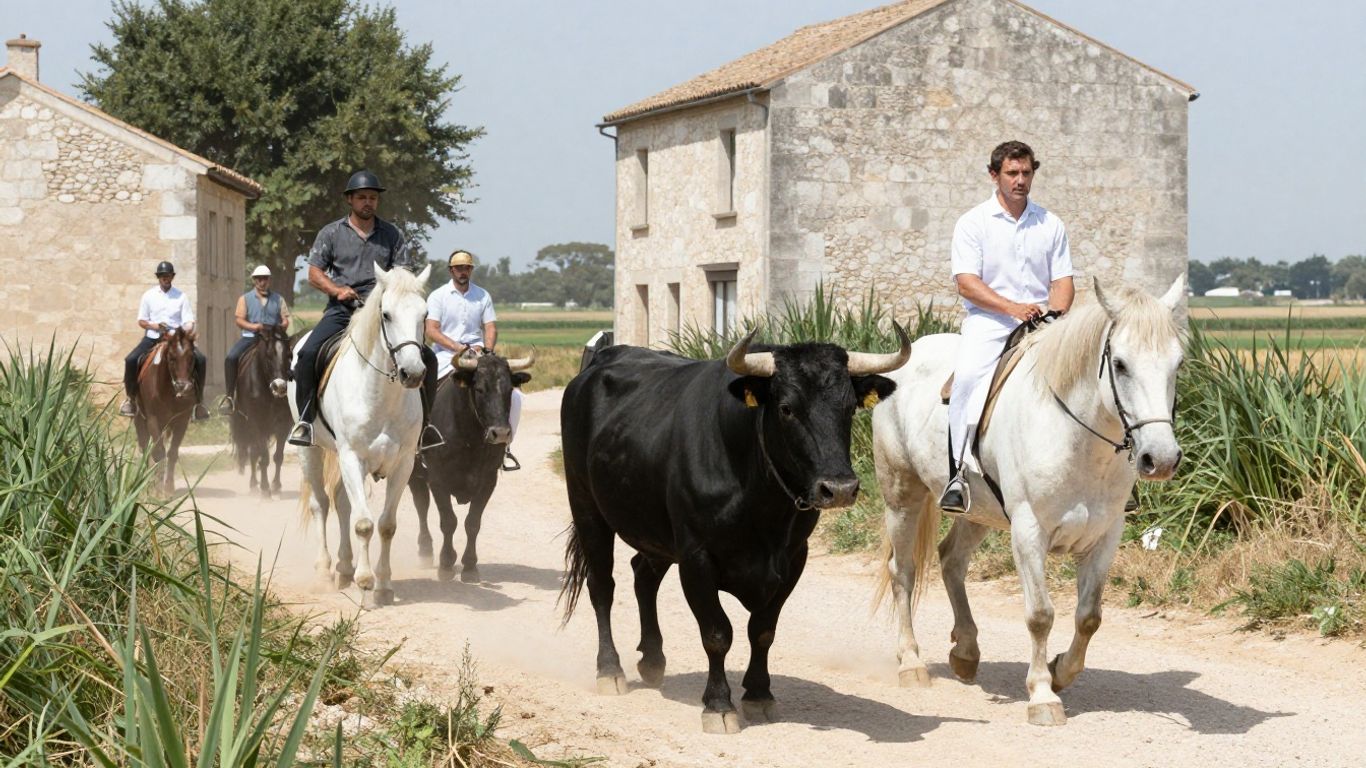
An abrivado traditionally involves bringing bulls from pasture toward an arena or another destination. Mounted guardians guide and control the herd along the route. The riders work together to keep the bulls moving in a compact group and to prevent them from breaking away. In modern festivals, spectators and protective arrangements may line the route. The event still depends on coordinated horsemanship and close knowledge of the animals.
How the bandido marks the return journey
The bandido is commonly associated with taking the bulls back after the event, often toward their pasture or manade. Its direction is thus the reverse of the abrivado, although local usage and festival programs can vary. The return may appear more relaxed, but a herd can change direction quickly, especially when noise, movement, or an opening affects its path. Treat the bandido with the same seriousness as the arrival.
Where spectators typically gather along the route
Spectators usually gather behind barriers or in areas designated by organizers, often near a village street, square, or open section of the route. The best spot isn’t necessarily the closest one. A clear view from a stable position is preferable to standing beside a corner, gate, or narrow passage where the herd may compress. Arrive early enough to understand the route and leave room for residents and event staff.
Why the atmosphere can change quickly
Crowds may cheer, move, or react suddenly when a bull tests the edge of the group. Horses and riders also need space to correct the herd, so a moment that looks playful from a distance can become concentrated and fast-moving. Keep children close and avoid stepping into the route for a photograph. The event’s energy is part of its appeal, but distance and attention are what make it possible to watch responsibly.
The ferrade: A closer look at ranch traditions
The ferrade offers a different perspective on Camargue bull culture because it takes place on a ranch rather than along a festival route. It is connected with identifying young animals and marking their place within a manade. Some ferrades are organized as cultural visits or demonstrations, while others remain private working occasions. Ask in advance what kind of visit is offered and whether visitors are expected to remain in a specific viewing area.
What the ferrade ceremony involves
A ferrade generally involves catching and marking young bulls, traditionally with a heated branding iron. Experienced ranch hands and guardians carry out the work, using horses and other equipment to manage the animals. The exact format can differ between manades and events. Visitors should follow the host’s instructions and avoid assuming that a public demonstration permits them to approach the animals.
How young bulls are branded and identified
Branding has historically helped identify which manade an animal belongs to. Other records and visual characteristics may also help ranchers distinguish animals as they grow. The process is practical, but it can be emotionally difficult for visitors unfamiliar with livestock work. A good guide will explain what is happening, why it is done, and how the animals are handled before and after the marking.
What visitors may see at a manade
A manade visit may include pastureland, Camargue horses, ranch buildings, demonstrations, or an explanation of how bulls are selected and managed. Some visits combine a ride or drive across the property with a meal or a talk from the people who work there. For travelers who want a wider rural experience, horseback tours in the Camargue can complement a manade visit. The two experiences are not identical.
Questions to ask about animal welfare and event practices
It is reasonable to ask how animals are transported, how long a public event lasts, and what measures are used to reduce stress. Visitors can also ask whether the ferrade is a working activity, a demonstration, or part of a festival program. The answers may vary by ranch, so avoid treating one explanation as universal. Calm, specific questions usually lead to a better understanding than a judgment formed before seeing the work.
Course Camarguaise and the role of the bull
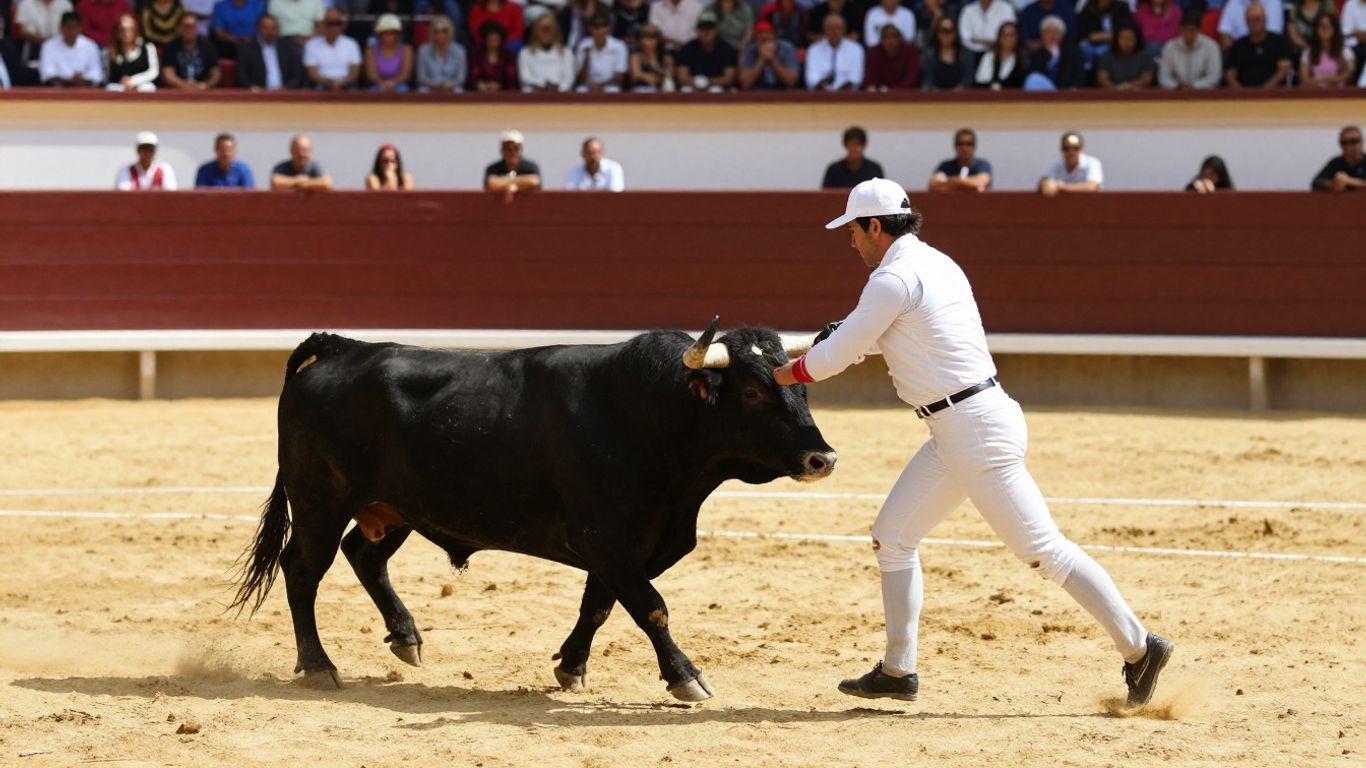
Course camarguaise takes place in an arena and is separate from bull running, even though both traditions involve Camargue bulls. The sport is non-lethal and places considerable attention on the bull’s agility, reactions, and reputation. Raseteurs enter the ring to make precise passes near the animal’s horns. For many local audiences, the bull is the central figure of the contest, not merely an obstacle for the athletes.
How the non-lethal sport is structured
A course camarguaise program generally brings bulls into the arena one at a time. Raseteurs then attempt a series of carefully timed passes. Each bull remains in the ring for a limited period before another takes its place. The event builds throughout the afternoon as the audience learns each animal’s qualities. Rules, scoring, and program details can be explained at the arena or in the local festival material.
What raseteurs attempt to remove from the bull
Raseteurs try to remove objects attached between the bull’s horns, including a rosette or cocarde, tassels, and strings. They use a small hooked instrument and must judge distance, speed, and the bull’s likely movement. The action looks rapid, but success depends on timing and familiarity with the animal. The bull’s responses shape the contest as much as the athlete’s technique.
Why the cocardier is respected by the community
The cocardier is the bull that takes part in course camarguaise. Individual animals can gain recognition for their intelligence, courage, and distinctive style. Knowledgeable spectators care about their names and the manade they come from. A respected bull may become a lasting part of local sporting memory. This helps explain why the event is often discussed as a meeting between skilled athletes and a valued animal, rather than a simple human-versus-animal spectacle.
How course camarguaise differs from bull running
Bull running takes place along a route and centers on guiding a herd safely from one location to another. Course camarguaise takes place in an enclosed arena and centers on individual passes by raseteurs. One is primarily a movement through public space; the other is a structured sporting contest. Seeing both, if schedules allow, gives visitors a clearer sense of the breadth of Camargue bull traditions.
Planning a visit around Camargue bull events
Planning Camargue tourism requires more than finding a date on a tourism calendar. Events can be attached to village festivals, religious celebrations, ranch programs, or arena schedules, and details may be announced locally. Arles, Saintes-Maries-de-la-Mer, and smaller nearby towns each have their own rhythm. Plan your travel: the best ways to reach the Camargue can help you decide whether a car, bus, or train suits your plans.
Choosing between village festivals and manade visits
A village festival offers the energy of a public gathering, with music, food, crowds, and a route-based event. A manade visit is usually slower and more explanatory, giving you a chance to learn about ranch work and the animals’ environment. Families or first-time visitors may prefer a guided ranch experience before attending a large abrivado. Travelers who want both should leave enough time between activities rather than trying to fit them into one hurried day.
When events commonly take place
Bull-related events are especially common during the warmer months. Village festivals and arena programs are active during this period, although local calendars can extend beyond the main season. Exact timing differs from one town to another and may shift with the festival program. Confirm the date, start time, and location shortly before traveling. A general seasonal assumption is not a substitute for an official local announcement.
Finding schedules in Arles, Saintes-Maries-de-la-Mer, and nearby towns
For Camargue France tourism information, look at municipal tourism offices, town websites, arena programs, and festival organizers’ announcements. Ask your accommodation host whether a route has changed or whether parking restrictions are expected. The following planning details are worth checking together:
| Detail to confirm | Why it matters | Where to look |
| Event type | An abrivado, bandido, ferrade, and course camarguaise are different experiences | Festival or arena program |
| Route or venue | Roads and viewing areas may be closed or redirected | Municipal notices |
| Start time | The published time may refer to gathering rather than the bull movement | Organizer announcement |
| Transport and parking | Rural and coastal areas can have limited services | Tourism office or accommodation |
Once these details are clear, build in extra time for walking and finding a safe viewing position. A schedule helps, but on-the-day instructions take priority over a saved itinerary.
What to expect from changing weather and event times
Camargue France, can feel exposed, with strong sun, wind, sudden showers, and insects depending on the season and location. Outdoor events may start later than expected or be adjusted when conditions change. Bring water, sun protection, and a light layer, and wear shoes suitable for uneven ground. The region’s flat terrain can make weather feel more noticeable, especially when you are waiting beside an open route.
Staying safe as a spectator
Bull-running events are organized with local knowledge, but they are not risk-free spectacles. A visitor may not recognize how quickly a herd can turn or how much space riders need to work. Watch the people managing the route and copy the behavior of experienced spectators. Safety is less about finding the most dramatic viewpoint than about remaining predictable and out of the animals’ path.
Where to stand during an abrivado or bandido
Stand behind official barriers or in a clearly designated viewing area, away from bends, gates, and narrow points. Do not lean over a barrier or stand where a crowd could push you into the route. Keep bags and loose items secure. If the area becomes crowded, move back rather than trying to hold a front-row position.
Why barriers and local instructions matter
Barriers create working space for bulls, horses, and guardians, not just to separate spectators from the show. Organizers may open or close sections as the herd approaches. Follow event staff requests immediately, even if the instruction seems overly cautious. Local safety decisions depend on the route and the animals ahead, and visitors usually see only a small part of the situation.
What families should know before attending
Children should understand that the bulls are real working animals and that the crowd’s excitement does not make the route a play area. Place young children well behind the main line of spectators and keep them within reach. Families should also plan an easy exit in case someone becomes frightened or the heat becomes uncomfortable. These practical steps make the experience calmer for everyone:
- Explain before arrival that no one may enter the route.
- Choose a viewing place with a clear way out.
- Keep children beside an adult rather than on a barrier.
- Bring water, sun protection, and hearing protection if needed.
After choosing a position, stay there unless staff directs the crowd to move. Children often take cues from adults, so a calm, attentive example is more useful than repeated warnings once the event has begun.
How to behave if a bull leaves the expected route
Do not rush at the animal. Do not yell in a way that scares it, and do not rush toward it to get a closer shot. If staff tell you to, step behind a strong barrier or move into a nearby building. Keep space open so the caretakers and emergency crews can get through. Do not make abrupt motions that might shove other people ahead. Stay put until local staff confirm it is safe, then go back to your viewing spot.
Showing cultural respect during the festivities
Visitors are welcome at many Camargue events, but attendance does not make every tradition a performance designed for tourists. The festivals are an important part of Camargue culture and belong to the communities that organize, fund, and maintain them. Show respect through small actions: follow instructions, buy from local vendors, and let residents enjoy their own celebrations. A practical travel guide should help you take part without flattening the culture into a photo opportunity.
Appropriate clothing, photography, and crowd etiquette
Wear comfortable clothing and closed shoes suited to dust, uneven surfaces, and changing weather. Ask before photographing people up close, especially guardians, ranch workers, and children. Never step into a route or climb a barrier for a better image. Keep your phone ready only from a safe position, and put it away when staff or riders need the crowd’s full attention.
How to support local organizers and ranches
When possible, buy food, drinks, or local products from authorized vendors. Pay for guided visits rather than seeking informal access to private ranch land. Follow booking rules and cancellation policies. Supporting local Camargue tourism helps maintain the associations, venues, and working farms that make these traditions possible. It also gives visitors a more reliable, respectful way to experience the region.
Ways to learn from guardians and residents
Listen to explanations offered during a guided visit, at an arena, or through a local tourism office. Learn a few basic French terms, including abrivado, bandido, manade, and gardian, and remember that pronunciation matters less than genuine interest. Ask open questions about the event rather than demanding a simple verdict on the tradition as a whole. If you are exploring the landscape as well, a guided Camargue nature tour can add ecological context to the cultural experience.
Common visitor misunderstandings to avoid
Do not assume that every Camargue bull event is a corrida, that every festival has the same rules, or that a close view is automatically the best view. Do not confuse a manade visit with permission to wander through working areas. Finally, avoid judging the region only by a short public spectacle. The bull traditions make more sense when considered alongside the delta’s pasture, marshes, horses, and long-standing rural communities.
Conclusion
A visit built around the Camargue bull-running tradition can make Camargue France tourism more meaningful. It should include context, patience, and practical caution. Watch how guardians work, learn the difference between an abrivado, bandido, ferrade, and course camarguaise, and let local instructions shape your experience. The result is not simply a dramatic afternoon, but a closer understanding of one of the Camargue’s living regional traditions.
Frequently Asked Questions
Is Camargue bull running the same as Spanish bullfighting?
No. Camargue bull running generally involves moving bulls with mounted guardians, while course camarguaise is a non-lethal arena sport. These customs differ from Spanish bullfighting in their objectives, setting, and treatment of the bull.
What is an abrivado?
An abrivado is a traditional movement of bulls, usually from pasture toward a village, arena, or another destination. Mounted guardians guide the herd and work to keep it together along the route.
What is a bandido?
A bandido is commonly associated with the return journey of bulls after an event, often toward pasture or the manade. Local programs may use the term slightly differently, so check the event description.
What happens during a ferrade?
A ferrade generally involves catching and identifying young bulls, traditionally through branding. Public versions may include explanations or demonstrations, while other ferrades are private working activities.
Is course camarguaise dangerous for the bull?
Course camarguaise is a non-lethal sport. Raseteurs attempt to remove objects placed between the bull’s horns, and the bull is not killed as part of the contest.
Where should spectators stand during an abrivado?
Spectators should remain behind official barriers or in areas designated by organizers. Avoid corners, gates, narrow passages, and any position that could place you in the herd’s path.
Can children attend Camargue bull events?
Children can attend when accompanied closely by adults and kept well behind barriers. Explain beforehand that the animals are real and that spectators must follow staff instructions immediately.


