

Annecy’s Old Town Canals: Why It’s Called the Venice of the Alps

Part of our Annecy travel guide
Annecy France, is known for a bright blue lake. You also get mountain views and pretty old streets. In the center of old town Annecy France, canals run through the area. People often call it the “Venice of the Alps” because of that.
The old town sits along the Thiou River. You can also see medieval buildings close by. Short waterways connect the lake and the hills. When you walk the paths beside the water, you notice painted fronts on houses. There are stone bridges, too. You keep finding small quiet spots around each bend. That is why Annecy stays so loved as a travel stop in France.
Key Takeaways
- The Palais de l’Île is the most recognizable landmark on the canals.
- The old town is best explored slowly, with detours through arcaded streets and bridges.
- Early mornings and shoulder seasons usually offer a quieter experience.
- Cobblestones and narrow passages make comfortable shoes useful.
- The canal walk pairs easily with markets, museums, lake activities, and local food.
Understanding Annecy’s “Venice of the Alps” nickname
Annecy is known by a nickname linked to how water moves through the old part of town. It flows under the bridges and slips along the sides of buildings that sit close together, mostly from medieval times.
The whole scene feels small in scale, not overly big or showy. The canals and streams are brief. They stay near the roads people use every day.
You also see soft pastel fronts and lots of flowers on windows. There are arcades too. The light from the nearby mountains changes how the streets look through the day. That mix is a key part of what makes the historic center stand out. If you want a quick setup before you get there, this Annecy travel guide can help. It focuses on the Vieille Ville and points you toward the main sights.
How the Thiou River shaped the old town
The Thiou brings water from Lake Annecy and runs through the old center. After that, it keeps going toward the Fier River. People built along it, so you can see choices about streets, bridges, and work areas that match the river’s path. Over time, the Thiou became part of daily town life, not just something to look at. Long ago, crafts and workshops used the water’s force. Later on, homes and shops stayed close to the banks too.
Today you can walk along the river, and it is not hard to keep track of. Still, it does not stay in view for long. You catch it in quick flashes when you pass between streets and around the edges of buildings.
I like that the scene keeps shifting. First you spot a tight stretch of water with a small stone bridge. A few steps later, the view swings out to a broader quay. Cafés line that stretch, and you can see them once you turn the corner.
What makes Annecy’s waterways different from Venice’s canals
Annecy and Venice share a visual relationship with water, but their settings differ. In Annecy, the water system ties in with the Thiou and its smaller streams. The old town stays easy on foot, set in an Alpine style area next to a quiet freshwater lake. You are not trying to cross a tangle of big canal routes. Instead, you pass through a small old core where paths and water show up again and again, and where streets and open squares keep coming together.
The comparison is therefore about atmosphere rather than scale. The canals and rivers are part of everyday life here. You can look past the roofs and see the Alps, and the lake is not far on foot. Those details help Annecy feel like itself. It does not seem like a smaller copy of some other place.
The role of bridges, arcades, and pastel façades
Bridges provide the classic viewpoints, especially where two branches of the water appear to frame the Palais de l’Île. Arcades create sheltered passages along some streets, offering shade in summer and cover during rain. Together, these features make the walk varied even when the distances are short.
Those bright fronts are more than a pretty background. What you see in them shifts as clouds move and the sun moves too. The little things matter, like the shutters, the balconies, and the flower boxes by the windows. When you take a photo, try looking up as much as you look toward the water.
How the canals influenced trade and daily life
The waterways once supported work and movement. Craftspeople and other residents settled near the Thiou, using its flow and its position within the town. Bridges connected neighborhoods, and the river provided a practical organizing line for commerce and local routines.
You might miss that earlier work when you only look at the postcards. Still, it tells you why the canals cut right through the old town, instead of hugging the border. If you want the connection, do this in your head: move back and forth between the quays and the lanes next to them. Keep watching. One moment you are looking at water, and the next you are facing shops, churches, and houses.
Following the main canals through Annecy’s old town
Wandering by the canals in Annecy feels calm, not forced. Instead of following one fixed route, you can just take your time. Many of the best places are close to each other. That makes it simple to slow down or speed up as you want. I often pop into the old town too, even if it is only for a short break.
Start at the Palais de l’Île. Then use the Thiou as a guide and head toward the lake. When you pass a bridge and the view looks nice, stop for a moment. Look around, then walk on.
You could hurry along the route, but the moment you stop for photos, grab a quick drink, or check out a market stall, the whole thing feels calmer. If you are going to stay for two days, take it easy with your schedule. Then you can see the old town, spend time along the lake, and also fit in a few nearby viewpoints.
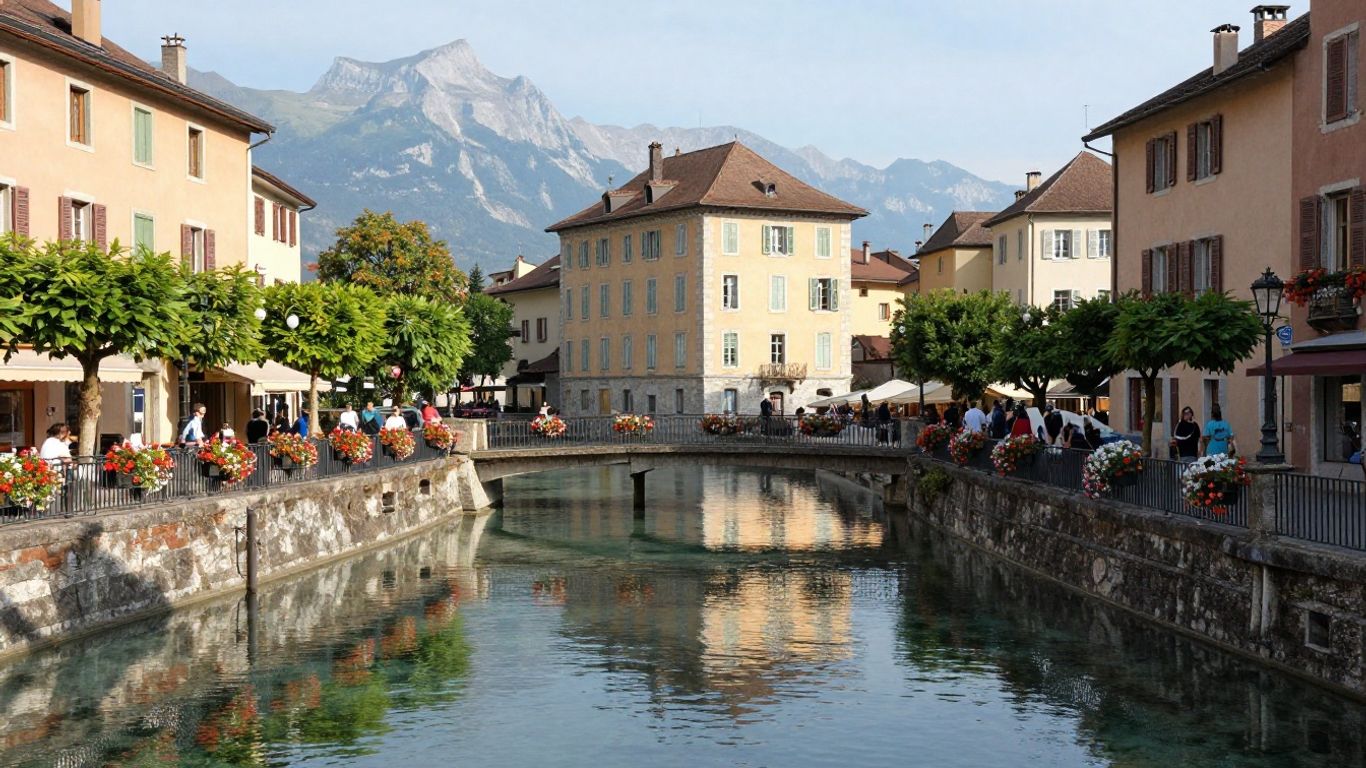
The walk can be completed in a short time, but stopping for photographs, coffee, or a market stall makes it feel more unhurried. If you have two days, a relaxed Annecy itinerary can help balance the old town with the lake and surrounding viewpoints.
Start at the Palais de l’Île
The Palais de l’Île feels like the first place to start. Its stone mass is right on the Thiou, and you can spot it from a few nearby bridges. The shape is sharp and looks a bit like a ship’s bow, so it stands out in the water. From the quays around it, you also get several different views of the building.
Begin by walking around the nearby bridges rather than taking just one photograph. From each position, the relationship between the island building, the water, and the pastel houses changes slightly. The adjacent lanes also lead quickly into the older parts of the center.
Follow the Thiou toward the old town streets
Walk on from the Palais de l’Île. Keep going along the water. When the buildings start to pull your attention, slip into the pedestrian lanes. This walk is not one long straight stretch. You will see more if you look at the place through the river paths and the street ways at the same time.
Look for moments when the river narrows beneath a bridge or disappears behind a row of buildings. These transitions show how compact Annecy is. A few minutes of walking can take you from a busy restaurant-lined quay to a quieter medieval passage.
Cross the Pont des Amours and nearby waterways
The Pont des Amours is close to where the old town, the lake edge, and the gardens meet. You can use it to keep going on a longer walk without going only through the tightest canal lanes. From there, you get to look out over the water, the trees, and the mountains in the distance.
Walk across at an easy pace. Stop for a moment on both sides. Look at how the city canal feels, then glance toward the wider lake view. The nearby water is not as boxed in. After those tight old town lanes, the open feeling shows up right away.
Extend the walk to the Jardins de l’Europe and Lake Annecy
Keep going through the Jardins de l’Europe if you want the canal route to feel gentler. The trees and the walking paths help cut up the cobblestone feel. At the lake side, you get more open views, plus benches where you can stop for a bit. From here, it is also a good time to think about what to do next, either head back toward the old town or keep following the shoreline.
For a longer outing on the water, Annecy Lake boat tours describe cruises and other ways to see the lake from a different perspective. The lake extension is not necessary for Annecy France travel, but it shows how directly the old town connects with its wider Alpine setting.
Historic landmarks to see along the waterways
Annecy feels easier to take in on foot. The canals help, and you can reach several key sights without going far. You do not have to look at each place as a separate stop. Watch how the streets line up with the bridges, how churches and other religious buildings appear near them, and how older defensive spots relate to the rest. Walk the area and you get a lot of size changes along the way. Some sections feel close and quiet, then you reach spots with wider views.
If you plan ahead, it is easier to see the interiors. The opening times and ticket rules can change. Sometimes a place is shut, but you can still check the area around it. It is often interesting to look at the building from outside in the old town.
Palais de l’Île and its distinctive triangular shape
The Palais de l’Île sits on a rocky piece of land in Thiou. It has a triangular shape, and that odd outline makes it easy to spot right away. The stone walls are heavy, and the place is tight against the water. All of that hints that it once served roles tied to control and protection. When you look at it from a nearby bridge, the river splits as if it goes around the building, which makes the place feel even more distinct.
Take a moment and look at it from different angles. From the nearest spot, you notice the brickwork and the narrow pointed end. If you step back a bit, you can see the nearby homes too, along with both sides of the waterway.
The medieval streets around Rue Sainte-Claire
Rue Sainte-Claire gets talked about a lot for its arcades and old building fronts. People like walking there because it feels made for pedestrians. Some parts of the street run alongside the water, so it is simple to stop by after you visit the Palais de l’Île. The covered sections are especially useful during strong sun or light rain.
The street makes it clear that Annecy is still a real place. It is not just something to look at from the outside. You pass old buildings with shops and cafés inside, and people live there too. If you walk slowly and watch for doorways, the neighborhood feels the way it should.
Saint-Maurice Church and the canalside views
Saint-Maurice Church sits in the old part of town. Between the busy streets, it feels more calm and easy to miss if you rush. Spend a little time inside, and you can notice small details. Walk around the outside too, because the work is there as well. After that, the nearby roads steer you back toward the water and the bridges.
The church works well as part of a short loop rather than as a separate destination. After seeing it, return toward the canals to compare the enclosed atmosphere of the historic streets with the brighter reflections along the quays.
Annecy Castle above the old town
Annecy Castle sits over the old town. From the canal area, it feels like a tall point you notice right away. To get there, you have to walk uphill. The effort is part of it, since once you reach the top you can see more of the rooftops below. That higher spot also helps you understand why the town mattered in the past.
You can list the main landmarks one after another. The order you get is not fixed. It changes based on which side you come in from when you enter the center. This overview keeps the walking relationships clear:
|
Landmark |
Setting |
What to notice |
|
Palais de l’Île |
In the Thiou |
Triangular stone form and bridge views |
|
Rue Sainte-Claire |
Arcaded old-town street |
Medieval façades and sheltered passages |
|
Saint-Maurice Church |
Historic center |
Religious architecture near the canal lanes |
|
Annecy Castle |
Above the old town |
Elevated position and broader town views |
This arrangement works because it combines waterfront stops with one uphill viewpoint. If time is limited, prioritize the Palais de l’Île and the streets around it, then add the castle when you want a wider perspective.
How to plan an Annecy old town canals guide
Exploring old town Annecy France is easy, but a good plan prevents the walk from becoming rushed or uncomfortable. Consider the time of day, the weather, and whether you want to include the lakefront or castle. An effective Annecy travel guide should leave room to wander while still offering a sensible starting point.
The town is popular, especially on warm weekends and during holidays. Checking seasonal conditions before traveling can make the experience more predictable; this guide to the best time to visit Annecy compares quieter periods with the busier summer months.
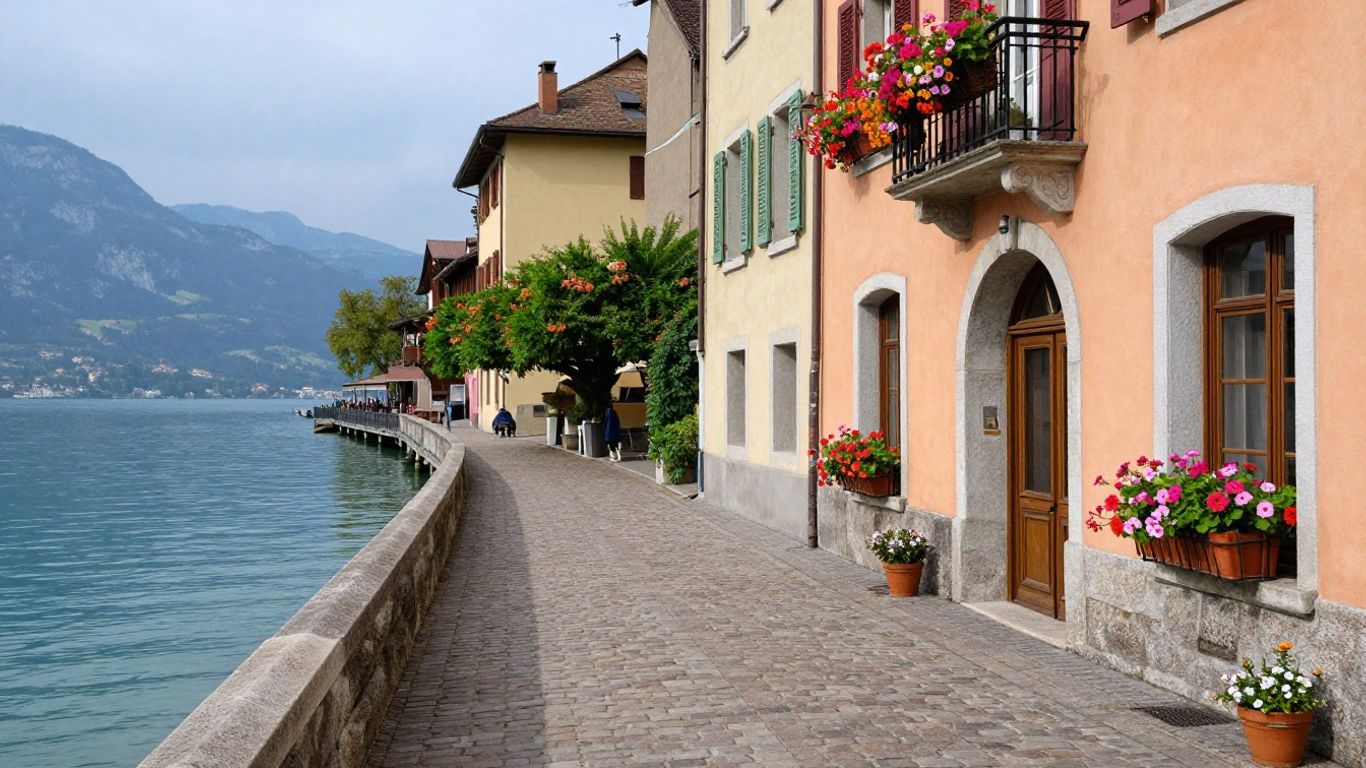
Best times of day for a quieter walk
Early morning is usually the calmest time to see the most photographed canal views. The light can be gentle, streets are less crowded, and bridges are easier to use without stopping traffic around a photograph. Late afternoon can also work well once some day visitors have left.
Midday is still enjoyable, especially for lunch and shopping, but the narrow lanes can feel busy. If photography matters, make the Palais de l’Île your first stop and save the market streets for later.
How long to allow for the canal route
A direct look at the main waterways can take less than an hour, but that is only the walking time. Most visitors will want longer for bridges, photographs, historic streets, food, and pauses beside the lake. Allowing two to three hours creates a comfortable half-day segment without requiring you to visit every landmark interior.
If you add Annecy Castle, a museum, or a longer lakeside stroll, plan for more time. The route is short in distance but rich in interruptions, which is precisely why a strict timetable can be counterproductive.
Where to begin from the train station or lakefront
For Annecy France travel, start at the train station. Walk toward the historic center. When you get to the canals, treat the Palais de l’Île as your first landmark.
Next, head to the lakefront. Go through the Jardins de l’Europe. Then cross close to the Pont des Amours. After that, enter the old town.
Either direction works. Beginning at the station is convenient for a day trip, while starting by the lake gives the walk a gradual transition from open water and gardens to bridges and medieval streets. These are the main practical choices to make before setting out:
- Start early if the Palais de l’île is a photo priority.
- Wear shoes with steady soles for uneven cobblestones.
- Leave time for unplanned lanes and bridge viewpoints.
- Check weather conditions before adding a long lakeside extension.
These simple choices make the route more flexible without adding much preparation. Once inside the old town, the main challenge is usually deciding which attractive detour to skip.
Accessibility, cobblestones, and walking considerations
Many central streets are pedestrian-friendly, but cobblestones, narrow passages, and occasional slopes can tire some visitors. The castle approach is notably less level than the canal quays. If mobility is a concern, focus on the flatter waterfront sections and check current access details for individual sites.
Busy crowds can make it feel less comfortable. This is true near bridges where the space gets tighter, or when outdoor tables take up room along the quay. If you move in a calm way and skip the busiest times, you may notice a bigger change than rushing just to go farther.
Best viewpoints, photos, and seasonal experiences
Annecy’s canals look good in photos for a simple reason. The views change fast even when you stay in one small area. In one walk you can catch a mirror like water close by, then bright building faces, then quiet shaded arcades. After that you might see wide views of the lake, and then the mountains line up in the distance.
I also think the best pictures come from stopping for a moment. Not from trying to hit every famous spot on a list.
Weather changes how the water looks. When the sun is out, the water shows brighter tones and stronger reflections. On cloudy days, the colors look less sharp, and the contrast drops. Then the older stone buildings also seem a bit more moody and distant.
Capturing the classic Palais de l’Île reflection
Near the Palais de l’île, the bridge view tends to look the same each time. You will see stone edges that rise above the Thiou, then the two rows of buildings on both sides. The water sits in front, so it frames everything.
If you want a clear scene, go early. Then shift a bit lower so you catch the reflection. Keep it balanced though, so the nearby fronts and façades still show.
When the water is calm, reflections look clearer. If there is a slight ripple, it can make the surface look more interesting. Try taking a couple of shots from several bridges. Do not just pick the nearest spot and assume it will be the best angle.
Finding colorful façades and flower displays
The old town looks brighter by the quays, with painted fronts and little window boxes. You will also see hanging baskets along the water.
If you skip the big landmark for a moment, there are smaller bits to spot. Try the rail on the bridge. Notice a single bright shutter. Watch too for a thin row of homes in the water channel, all caught in the reflection.
Morning light can reveal softer colors, while later daylight may bring stronger contrast to the façades. Avoid blocking doorways or busy footpaths when stopping, since the old town remains part of everyday life.
Comparing the canals in summer, autumn, and winter
Summer brings long days, open cafés, flowers, and the most active lakefront. It also draws the biggest crowds, so getting there early helps a lot. In autumn, you can see warmer leaves and the days feel less rushed. When it is cooler out, longer walks are easier too, as long as you dress right.
Winter can give the canals a quieter, more subdued appearance. Some businesses or attractions may use reduced schedules, so check practical details in advance. For a seasonal trip, pack for changing Alpine weather rather than relying only on the town center forecast.
Seeing Annecy’s waterways after dark
After sunset, lighting around the old town and bridges changes the canals’ mood. Reflections become darker and more defined, while illuminated façades stand out against the water. Keep an evening walk short and familiar, especially if the cobblestones are wet.
In the evening, you can take your time with a slower meal or a drink after you finish the main sights. When you feel done, head back to the busy streets that are bright and easy to follow. Try not to turn every tight alley into part of your night walk.
What to do beyond the canal walk
The old town is a great way to start in Annecy. It is one of the best places to visit in Annecy you can make, but it does not tell the whole story. There are markets there too, along with places to eat and spots tied to local culture. You can also get to the lake without much hassle. If you mix a couple of these, then add time on the water, you end up with a more complete day. You do not need to squeeze everything into a tight plan.
Annecy is in a good place, so you can move from walking around town to being outside with less hassle. When you plan your day, leave some room for rain, stop for food when you need it, and expect that the lake area may take longer than you thought at the start.
Browse the markets and local shops
The market gives a more normal look at the area. You will see local fruit and food from nearby regions. Stalls are placed along the old streets, so the walk feels close to the place itself.
Plans can shift. Check what is going on near you before you lock in your morning. You might also spot small shops and quick food stops. Many of them are easy to reach from the canals.
The best approach is to browse without rushing. A market stop can supply picnic ingredients for the lakefront or provide a break between landmark visits.
Try Savoyard specialties near the old town
Annecy is a good spot if you want to taste foods from Savoie. You can find plates that use local cheese, potatoes, and cured meats. If you eat near the old town, you can stop in after a walk by the canal. Just note that the main dining streets get crowded around lunch and dinner.
Before you move on, think about what you need. Pick either a filling meal in the area or a quick stop at a café. If it is a busy time, booking ahead can make things easier, mainly for dinner.
Combine the canals with Lake Annecy activities
At the lake, you can do more than just sit and look. There are boat trips, paths by the water, bike routes, and activities that come and go with the season.
If you stop only briefly by the shore, the whole day still feels different than it does in the old town, where the lanes feel tight and enclosed.
Want to ride around the lake? Then give yourself extra time. The trip takes longer than the canal route would.
A boat trip is another way to see the surrounding mountains and lakeside settlements without repeating the old-town walk. The key is to treat the lake as a separate outing or a relaxed extension, not as a minor detour that must fit into a tight hour.
Visit museums and cultural sites nearby
Museums and historic interiors are among the places to visit in Annecy that add context to the buildings seen from the quays. Annecy Castle is the most prominent elevated cultural stop, while other sites in and around the old town can add local history, art, or regional perspective.
Opening days and hours may change by season. Check them before you set out, then keep the canal walk flexible so a closed door doesn’t disrupt the whole day.
Conclusion
Annecy France earns its “Venice of the Alps” nickname through the close relationship between the Thiou, medieval streets, bridges, and colorful waterfront buildings. Start at the Palais de l’île, explore the lanes around it, and extend the walk toward the gardens and lake when the weather allows. With comfortable shoes and a little flexibility, the old town’s short waterways become an easy, rewarding introduction to Annecy.
Frequently Asked Questions
How long does it take to walk Annecy’s old town canals?
You can see the main canal views in under an hour, but two to three hours is more comfortable if you want photos, historic streets, food, and a lakeside extension.
What is the most famous landmark on Annecy’s canals?
The Palais de l’Île is the best-known landmark. Its pointed stone shape sits directly in the Thiou and is especially recognizable from the nearby bridges.
Where should I start a canal walk in Annecy?
The Palais de l’Île is a practical starting point in the old town. Visitors arriving from the lakefront can also begin near the Jardins de l’Europe and Pont des Amours.
What is the best time to visit the canals?
Early morning is generally quieter and offers good light for photographs. Spring, autumn, and winter can also feel calmer than the busiest summer periods, though opening hours may vary.
Are Annecy’s old town canals accessible?
Many central streets are walkable, but cobblestones, narrow passages, bridges, and slopes can present challenges. The castle approach is more demanding than the flatter canal quays.
Can I combine the canal walk with Lake Annecy?
Yes. The lakefront, Jardins de l’Europe, and Pont des Amours are close to the old town. Plan longer cycling, boating, or lakeside excursions as additional activities.
What should I wear for exploring Annecy’s old town?
Comfortable shoes with steady soles are useful on cobblestones. Bring layers and weather protection because conditions can change between the shaded old town, open lakefront, and higher viewpoints.
Planning a trip to Annecy?
Compare hotels, guided tours, car hire and flights in one place.


