

Inside the Camargue Nature Reserve: What a Guided Tour Actually Shows You

Part of our Camargue travel guide
Key Takeaways
A guided visit makes the Camargue easier to understand, not simply easier to see. The right tour balances access, wildlife, local knowledge, and the practical conditions of a large wetland.
- Choose between land-based, walking, and boat-based exploration according to your pace and interests.
- Expect changing scenery, from lagoons and reed beds to salt flats and managed pasture.
- Guides help interpret animal behavior while keeping visitors at a respectful distance.
- Seasonal timing affects migration, nesting, light, insects, and water levels.
- Comfortable clothing, realistic expectations, and careful conduct improve the experience.
1. Choosing the right Camargue nature reserve guided tour
A camargue nature reserve guided tour can be quiet and observational or active and wide-ranging. The format matters because the reserve is broad, its roads and waterways reveal different habitats, and wildlife is rarely concentrated in one predictable place. Before booking, think about how much time you want outside, how far you are comfortable traveling, and whether birds, landscapes, or local traditions are your main interest.
Land-based safaris, walking tours, and boat excursions
Land-based safaris cover more ground and often use elevated viewpoints or tracks through open marshland. Walking tours slow the pace, making it easier to notice plants, tracks, insects, and small changes in the water. Boats offer another perspective on lagoons and channels, but they depend on departure points, weather, water conditions, and the rules of the waterway.
A useful overview of the region’s Camargue wetlands can help you compare the habitats you may encounter before choosing a format. A tour is most satisfying when its pace matches your curiosity rather than promising every possible sight in a single outing.
Half-day versus full-day itineraries
A half-day trip is usually enough for a first impression, especially if you want a focused outing around birds or a particular wetland area. A full-day itinerary allows more time for changing habitats and a longer pause when a flock, herd, or distant raptor appears. It also brings more exposure to sun, wind, heat, and uneven ground, so the longer option is not automatically the better one.
Consider travel time between locations as well as the advertised activity. In a large delta, a substantial part of the day may involve moving between marshes, pasture, villages, or the coast.
Small-group tours and private guides
Small groups are generally easier to manage at a viewpoint or along a narrow trail. They also allow more questions and make it simpler for a guide to adjust the pace when someone wants extra time with a telescope. A private guide can tailor the outing more closely, although the value depends on whether the itinerary genuinely reflects your interests rather than merely offering a higher price.
Ask how many people will be present, where the meeting point is, and whether transport between sites is included. These details often affect the experience more than the label attached to the tour.
Seasonal differences in wildlife viewing
Wildlife viewing changes with the calendar. Spring and autumn can bring migration, summer may offer long light and active landscapes but difficult heat, and winter can provide calmer trails with strong birdwatching opportunities. Flamingos, herons, horses, and cattle remain part of the wider Camargue story, but their location and visibility vary from day to day.
If a particular species matters to you, ask what is realistically typical for the season rather than requesting a guarantee. A good guide will explain both the possibilities and the limitations.
What to check before booking
The practical wording of a listing deserves close attention. Check the meeting location, transport, duration outside, cancellation policy, language, and whether binoculars are supplied. Also confirm whether the route is inside a protected reserve, on private working land, or along public roads, since each setting can offer a different kind of experience.
These questions are especially useful when comparing options:
- Is the tour primarily for birdwatching, landscapes, culture, or a mixture?
- How much walking is involved, and on what kind of surface?
- Are children, mobility aids, or visitors without a car accommodated?
- What happens if wind, rain, heat, or water conditions change?
The answers help you select a tour that fits the day you actually want, not an idealized version of the reserve.
2. Entering the wetlands and understanding the landscape
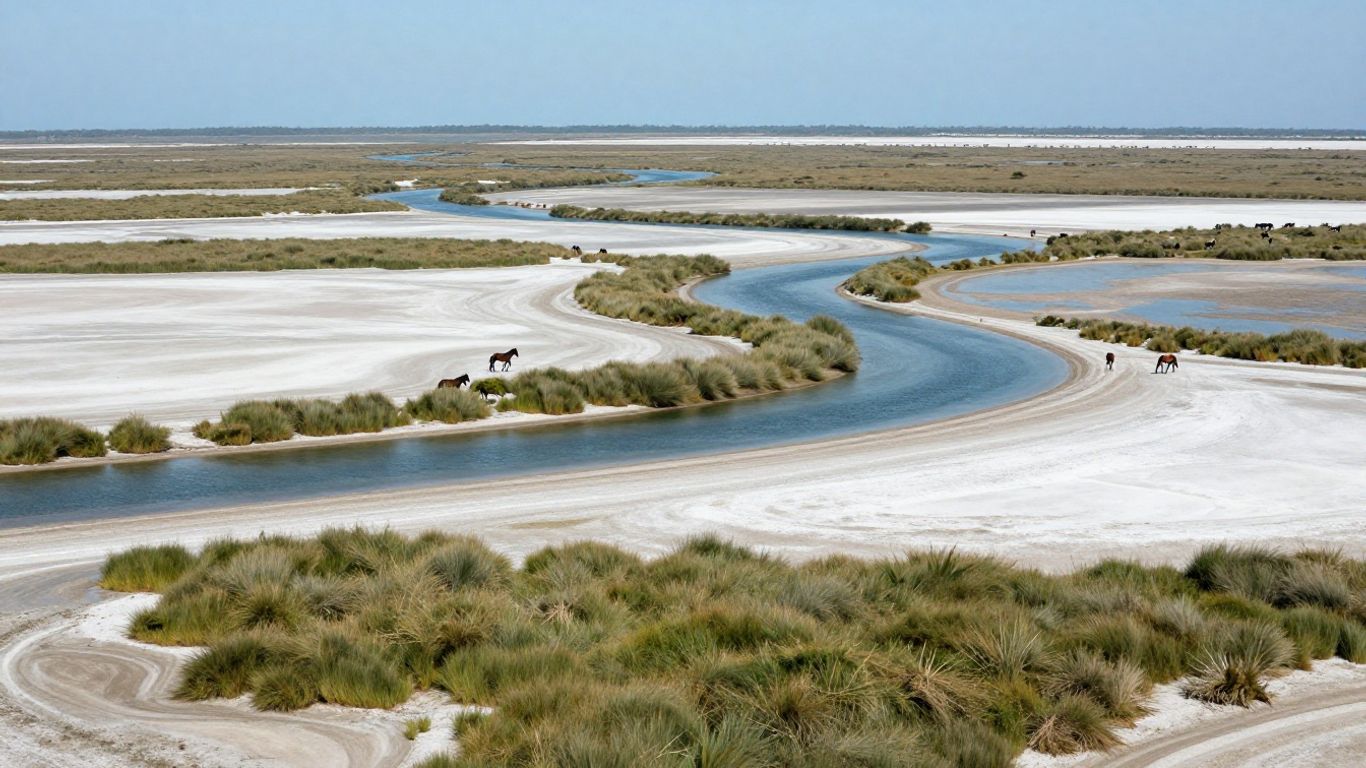
The Camargue is easier to read once you stop treating it as one uniform expanse. River water, seawater, rainfall, evaporation, embankments, agriculture, and grazing all influence what appears in front of you. A guide turns a broad view into a sequence of connected habitats, explaining why one stretch is bright with salt while another is green with reeds.
How the Rhône delta shapes the reserve
The Rhône delta is a meeting place between river and Mediterranean influences. Sediment, channels, coastal processes, and wind have shaped a low, open terrain where small changes in elevation can affect water and vegetation. From a track or observation point, the landscape may look flat, but its drainage patterns create meaningful differences between nearby areas.
Guides often use the horizon, dikes, channels, and vegetation lines to explain this structure. That context makes the scenery more legible and helps visitors understand why the reserve supports such varied life.
Freshwater marshes, salt flats, lagoons, and reed beds
Freshwater marshes support different plants and birds from salt flats, while lagoons create broad reflective spaces where waterfowl and flamingos may gather. Reed beds provide cover and nesting habitat, and open pasture gives large animals room to graze. The contrast can be subtle at first, particularly under strong sunlight, but a guide points out the clues.
Look for changes in plant height, water color, exposed mud, and the presence of shells or salt-tolerant vegetation. These details reveal the conditions beneath the apparently simple view.
The role of water management and seasonal flooding
Water management is part of the lived landscape. Dikes, sluices, channels, and pumping systems influence how freshwater and saltwater move, while seasonal rain and flooding alter the depth and duration of wetlands. Agricultural needs, wildlife habitat, flood control, and coastal processes do not always point in the same direction.
A useful tour does not reduce this subject to a tidy success story. It shows how the delta is continually adjusted and how those decisions affect both working land and protected habitat.
Why access is restricted in protected areas
Restricted access protects nesting sites, fragile vegetation, and animals that need undisturbed feeding or resting areas. It also limits erosion on narrow paths and prevents vehicles or large groups from spreading into sensitive zones. From the visitor’s perspective, a closed track can feel like a missed opportunity, but it is often part of the reserve’s management plan.
Staying on an approved route may mean seeing less territory while learning more from the places that remain open. Patience is a practical part of visiting a protected wetland.
How guides explain the Camargue’s fragile ecosystem
Guides connect visible features to wider pressures without turning the excursion into a lecture. They may discuss water salinity, habitat fragmentation, disturbance, invasive plants, farming, or the effects of storms and drought. The strongest explanations return to what you can see: a dry channel, a concentration of birds, or a changing line of reeds.
That approach gives the landscape a clear human and ecological context. It also explains why conservation here involves both leaving some places alone and carefully maintaining others.
3. Watching Camargue wildlife in its natural habitat
Wildlife is usually the main reason people book a Camargue tour, but the experience is less like visiting an enclosure than following clues across an open delta. Animals may be distant, hidden, or active for only a few minutes. The reward is not a guaranteed close-up; it is learning how a living wetland behaves when nobody is arranging the scene for visitors.
Greater flamingos and the best places to see them
Greater flamingos are among the reserve’s most recognizable birds, yet the best viewing place changes with food, water levels, weather, and disturbance. They may form a dense pink group on a lagoon or appear as scattered figures far beyond the track. A boat outing, roadside viewpoint, or dedicated birding area can each provide a different distance and angle.
A specialist flamingo-watching boat tour may suit visitors who want to understand how waterways shape sightings. Bring patience: the most memorable moment may be a flock lifting together rather than a single bird standing nearby.
Wild horses, Camargue cattle, and managed grazing
The pale horses and dark cattle associated with the Camargue are part of a working landscape as well as a visual symbol. Herds may graze in open pasture or be managed by people involved in local ranching traditions. Their presence helps maintain certain grassland conditions, but they are not tame props for photographs.
Keep a generous distance, particularly around young animals and bulls. A guide can explain behavior and local practice while preventing visitors from drifting toward a herd.
Herons, egrets, and other wetland birds
Herons and egrets reward a slower gaze. They may stand motionless at the edge of a channel, cross a patch of sky with deliberate wingbeats, or disappear into reeds before the group has finished looking. Coots, gulls, terns, ducks, waders, and birds of prey add movement at different levels of the landscape.
Rather than scanning randomly, watch the waterline and listen for calls. A telescope makes distant birds easier to identify, but the guide’s explanation of feeding behavior is often just as valuable.
Migratory species throughout the year
The Camargue sits within an important route for birds moving between breeding and wintering grounds. Spring and autumn can bring changing combinations of waders, ducks, passerines, and raptors, while resident species remain present between migration periods. Exact timing shifts with weather and food availability.
This makes repeat visits worthwhile. A familiar lagoon can look entirely different when a new group of birds arrives or when low water exposes feeding ground.
Why sightings are never guaranteed
Open nature does not operate on a timetable. Wind can push birds into sheltered corners, heat can reduce daytime activity, and a passing vehicle or sudden noise can empty a viewpoint. Even experienced guides may find that a hoped-for species is absent.
The best tours measure success by observation and understanding, not by a checklist alone. A quieter encounter can matter more than a dramatic photograph because it leaves the animal undisturbed.
4. Learning how guides find and identify animals
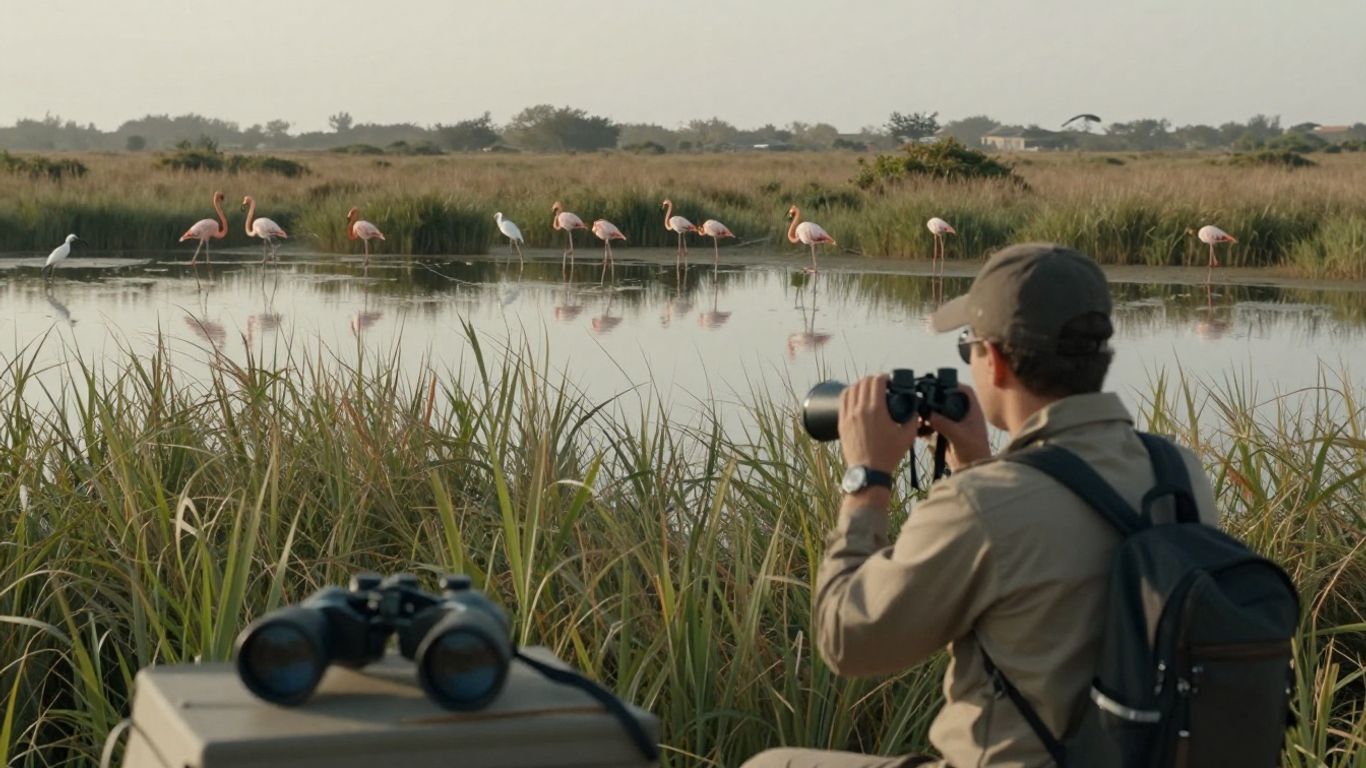
A guide’s skill is often most visible when nothing obvious is happening. They read the ground, water, sounds, and behavior, then decide whether the group should wait, move, or lower its voices. Visitors learn that wildlife spotting is a process of interpretation rather than a matter of simply looking harder.
Reading tracks, calls, feathers, and feeding patterns
Mud records movement surprisingly well. Tracks near a pool can indicate the size and direction of an animal, while feathers, droppings, disturbed reeds, and feeding marks suggest who has recently used the area. Calls are equally useful, especially when dense vegetation hides the bird producing them.
Guides combine these clues instead of relying on one sign. A quiet bank may therefore tell a story even when no animal is visible at the moment.
Using binoculars, telescopes, and field guides
Binoculars are useful for scanning broad marshes, while a telescope can separate distant shapes and reveal plumage details without requiring anyone to approach. Field guides help confirm identification, but they work best alongside habitat, season, behavior, and sound. Beginners should not feel pressure to recognize every species immediately.
A well-run outing allows everyone time to focus and refocus equipment. The guide should also explain where to look, since pointing toward an empty horizon is rarely enough for a first-time observer.
Approaching wildlife without causing disturbance
Responsible viewing begins before the animal reacts. Groups should stay on designated routes, avoid crowding a resting flock, keep voices low, and never use food to draw animals closer. Vehicles should stop only where permitted, with engines and doors handled carefully.
Distance is not a failure of the tour. It is part of the method, allowing the animal to continue feeding, nesting, or resting without changing its behavior for the sake of a photograph.
Understanding animal behavior from a safe distance
Behavior often provides more information than appearance. A bird repeatedly dipping its head may be feeding, a horse turning away may be signaling discomfort, and a flock rising suddenly may have detected a disturbance. Guides help distinguish ordinary movement from a response to the group.
This is where a tour becomes more than a list of names. You begin to see the reserve as a network of decisions made by animals responding to water, food, weather, and one another.
How guides adapt when conditions change
A guide may change the route when wind makes one observation point unproductive, when rain reduces visibility, or when an access area closes. The replacement plan might focus on sheltered reeds, open pasture, a different lagoon, or a cultural stop. Flexibility is especially useful in a landscape where conditions can change within an hour.
Ask about the guide’s approach to substitutions before setting out. A thoughtful adjustment usually protects the quality of the day better than forcing an unsuitable route.
5. Exploring the people and traditions of the Camargue
The Camargue is not a wilderness without residents or work. Ranching, salt production, fishing, rice cultivation, and tourism all shape the delta, sometimes visibly and sometimes through hidden infrastructure. A guided visit can show how local livelihoods depend on the same water and pasture systems that attract wildlife watchers.
The work of gardians and the culture of the manade
Gardians are traditional cattle and horse herders whose work is closely associated with the manade, a local ranch or herd operation. Their knowledge includes handling animals, reading pasture, and moving through difficult wetland terrain. A respectful guide presents this as skilled agricultural work rather than a decorative performance.
Visitors may encounter working ranches, equipment, or demonstrations depending on the itinerary. The setting matters: local culture is best understood where the work actually takes place.
Traditional cattle and horse herding
Herding depends on timing, terrain, animal temperament, and cooperation between people and horses. Cattle and horses are moved through pasture and enclosed areas for management, care, or local events. Seeing this process from a distance explains why tracks, gates, fences, and open grazing areas are part of the Camargue’s visual character.
Visitors should follow instructions around animals and avoid treating a working herd as a photo opportunity. The safest view is often the one that lets the work continue normally.
Salt harvesting and the region’s working landscapes
Salt production has left a distinctive pattern of shallow basins, embankments, and bright mineral surfaces. Evaporation gradually concentrates salt in managed ponds, creating colors that shift with water depth, algae, sunlight, and season. These landscapes may look untouched, but their geometry reflects sustained human activity.
A guide can help separate natural coastal processes from industrial or agricultural management. That distinction makes the view more precise and less dependent on postcard descriptions.
Fishing, rice farming, and life around the wetlands
Fishing and rice farming rely on access to water, though they use it in different ways and at different times of year. Rice fields can provide habitat for some species while also requiring careful control of inflow and drainage. Fishing communities, farms, roads, and canals show that the delta remains a lived-in place.
For visitors, these working areas are a reminder to drive slowly, respect private property, and avoid assuming every open track is a public path.
How local history connects to conservation
Conservation in the Camargue has developed alongside settlement, agriculture, engineering, and traditional occupations. Protected areas preserve habitats, while managed landscapes can also support biodiversity when water and grazing are handled carefully. History explains why current boundaries and rules may seem complex.
The most useful cultural interpretation avoids dividing the region into nature on one side and people on the other. The reserve’s present character comes from their long, sometimes difficult interaction.
6. Experiencing the reserve through the seasons
There is no single best season for every visitor. The Camargue changes through migration, nesting, heat, water management, pasture conditions, and the angle of the sun. Choosing a date should therefore depend on the experience you want, not only on a general promise of good weather.
Spring migration and nesting activity
Spring can bring returning migrants, active courtship, and the start of nesting activity. Birds may be vocal and easier to notice, but breeding areas also require extra care. Some paths or viewpoints may be restricted to reduce disturbance during this sensitive period.
Early starts can be rewarding because temperatures are gentler and many birds are active. They also require practical planning if your meeting point lies outside a major town.
Summer heat, insects, and changing water levels
Summer offers long days and strong light, but midday heat can make open tracks tiring. Mosquitoes and other insects may be more noticeable near still water, and water levels can change the appearance of marshes and feeding areas. Shade is limited in many parts of the delta.
Schedule demanding walks for the cooler part of the day when possible. A shorter tour with good observation stops may be more enjoyable than an ambitious route taken in peak heat.
Autumn migration and salt-marsh colors
Autumn migration can refresh familiar landscapes with new arrivals and changing flock patterns. Salt-marsh vegetation may take on copper, red, gray, or golden tones as conditions shift, especially when low sun catches shallow water. Wind can be stronger, however, and weather may become less predictable.
Bring an outer layer even when the forecast looks mild. The open terrain offers little protection when a coastal breeze develops.
Winter birdwatching and quieter trails
Winter often brings a quieter atmosphere and good opportunities to concentrate on birds without the intensity of peak travel periods. Some species are present in large numbers, while vegetation and low light can make identification a different kind of challenge. Horses and cattle remain part of the landscape, though daily activity varies.
Shorter days make departure and return times worth checking carefully. A guide who knows sheltered viewpoints can make a cold outing much more comfortable.
Weather and light conditions that affect a tour
Cloud, wind, fog, and rain change both visibility and mood. Soft light can improve detail on birds and reduce glare from water, while harsh midday sun may flatten distant subjects. Wind can carry sound away and make a telescope difficult to hold steady.
The forecast should inform your clothing and expectations, but it cannot predict every wildlife result. A flexible attitude is one of the most useful things to bring.
7. Preparing for a responsible and comfortable visit
Preparation is uncomplicated, but it has a direct effect on what you notice and how long you can stay engaged. The delta can feel exposed, and facilities may be separated by considerable distances. Plan for the conditions rather than assuming a pleasant coastal day will cover every need.
Clothing, footwear, sun protection, and insect repellent
Wear closed, comfortable footwear with enough grip for uneven or damp ground. Lightweight layers help with changing temperatures, while a hat, sunglasses, and sunscreen are useful in exposed areas. Insect repellent is sensible near marshes, particularly in warmer months.
Neutral colors can be comfortable for observation, though practical fit matters more than appearance. Carry water and keep a light rain or wind layer available when conditions are uncertain.
What to bring for photography and birdwatching
Binoculars, spare batteries, a camera with a long lens, and a small notebook can all be useful. Do not let equipment become a reason to move closer to animals; distance and patience usually produce better behavior and, often, better images. A phone can record notes even when it cannot capture a distant bird.
Pack only what you can carry comfortably. A heavy bag becomes noticeable on a long track, especially in heat or wind.
Accessibility and physical demands on different tours
Walking routes may involve uneven paths, loose sand, mud, steps, or long periods of standing. Boat tours can reduce walking but may involve boarding, narrow passages, or limited shelter. Land-based outings vary widely, so a general label such as “easy” does not tell the whole story.
Ask specific questions about surfaces, toilets, seating, vehicle access, and the distance between stops. Clear information gives the operator a chance to recommend a suitable option rather than making assumptions.
Wildlife etiquette and protected-area rules
Stay on marked paths, follow closures, keep dogs under the required control, and never feed or chase wildlife. Avoid loud playback of bird calls and do not remove shells, plants, feathers, or other natural material. If a guide asks the group to wait or move back, that instruction protects both the animals and future visitors.
Rules can differ between sites, so read local notices and listen to the briefing. Respect is practical here: it prevents accidents, disturbance, and damage to habitats that recover slowly.
Setting realistic expectations for the experience
A guided tour may produce a spectacular flock, a distant herd, or simply a careful explanation of an empty-looking marsh. All three are authentic parts of the reserve. The landscape rewards attention to small changes rather than demanding a dramatic event every few minutes.
Arrive ready to observe, ask questions, and adapt. That mindset leaves room for the Camargue to show you what is actually happening on the day.
Conclusion
A Camargue tour reveals a landscape shaped by river, sea, wildlife, working traditions, and careful limits on access. Choose a format that suits your pace, prepare for exposure and changing conditions, and allow the guide’s knowledge to slow your attention down. The reserve is most rewarding when it is treated as a living wetland rather than a checklist of sights.
Frequently Asked Questions
What is a camargue nature reserve guided tour?
It is a guided visit through or around Camargue wetlands, using walking routes, vehicles, boats, or a combination of formats to interpret wildlife, habitats, and local landscapes.
What animals might I see in the Camargue?
Common possibilities include greater flamingos, herons, egrets, other wetland birds, Camargue horses, and cattle. Sightings depend on season, weather, habitat, and the animals’ location that day.
Is a boat tour better than a land-based tour?
Neither is universally better. Boats provide a water-level perspective, while land-based tours may reach pasture, observation points, and habitats away from navigable channels.
How long should a Camargue tour last?
A half-day works for a focused introduction, while a full day allows more habitats and flexibility. The best length depends on travel time, walking comfort, and your main interests.
When is the best season for birdwatching?
Spring and autumn are often attractive for migration, while winter can offer quieter conditions and substantial bird activity. Summer brings long light but more heat and insects.
Can children join a guided visit?
Many tours can suit children, but the pace, walking distance, heat, and need for quiet observation vary. Check the operator’s age guidance and route details before booking.
What should I bring to the reserve?
Bring water, sun protection, suitable footwear, insect repellent, weather-appropriate layers, and binoculars if you have them. A camera is optional, but patience is essential.
Planning a trip to the Camargue?
Compare hotels, guided tours, car hire and flights in one place.


