

Your Perfect 7-Day Brittany Itinerary: An Unforgettable Road Trip

Brittany is made for taking it slow. Wild granite coastlines, medieval towns that look painted on, oysters straight off the boat, and a Celtic streak that makes it feel like its own little country. So forget cramming. This Brittany itinerary is built around a week of actually enjoying the place, a relaxed road trip that loops from the walled city of Saint-Malo down to the standing stones of Carnac. Seven days, a rental car, zero rushing. Here’s exactly how I’d spend a week in Brittany.
Key Takeaways
- This Brittany travel itinerary runs north to south over seven days, from Saint-Malo and the Pink Granite Coast down to Carnac and the Gulf of Morbihan.
- A car makes it. This is a Brittany road trip at heart, and the best bits sit on backroads the trains don’t reach.
- Pick two or three bases (Saint-Malo, Quimper, Vannes) instead of moving every night. Less packing, more lingering.
- The Brittany beaches and coastal paths are a highlight, especially the GR34 footpath and the rose-coloured rocks of Ploumanac’h.
- Come hungry. Galettes, Cancale oysters, and that ludicrous buttery kouign-amann are non-negotiable things to do in Brittany.
- Shoulder season (May, June, September) is the sweet spot: warm enough, quiet, and cheaper.
Your Week in Brittany at a Glance
Short on time to read the whole thing? Here’s the seven-day route in one breath.
Day 1: Settle Into Saint-Malo
Start in Saint-Malo, and honestly, it grabs you the second you arrive. A whole walled city sitting out in the sea, ringed by some of the biggest tides in Europe. Drop your bags, then do the one unmissable thing: walk the ramparts. They loop the entire old town, it’s free, and you’ll keep stopping for the views, English Channel on one side, granite rooftops on the other. Inside the walls it’s a cobbled maze, easy to get pleasantly lost in.
Duck into the Saint-Vincent Cathedral, keep an eye out for the Jacques Cartier memorials (the explorer set sail from here), and when the tide’s out, drop down to Plage de l’Eventail for a paddle. Before dinner, do yourself a favour and visit La Maison du Beurre Bordier, the artisan butter shop. Sounds daft, getting worked up about butter. You’ll understand after one taste. Stay here two nights.
One more thing for Day 1: the tides here are no joke, so check the times if you want to walk out to the offshore forts like the Fort National, which you can only reach at low tide. And if the budget stretches, sleeping inside the walls (intra-muros) is worth it for the after-dark, day-tripper-free version of the old town.
Day 2: Cancale Oysters and Medieval Dinan
Today you don’t go far, you just go well. Drive 20 minutes to Cancale, the oyster town. Down at the Marche aux Huitres, locals sell their morning haul straight off the boat. Grab a dozen, a squeeze of lemon, a plastic cup of white, and eat them on the sea wall while you lob the empties toward the gulls (genuinely the local move). Not an oyster person? A smoked-fish galette at a creperie like Chez Odette sorts you right out.
Walk off lunch at the Pointe du Grouin, all wind and jagged rock. Then swing inland to Dinan for the afternoon, a medieval town so well kept it’s almost silly. Wander down the Rue du Jerzual, the steep cobbled lane to the old river port, grab a Breton cider at L’Absinthe, and just amble. More of an Arthurian-legends type? Swap Dinan for the mossy oaks of the Broceliande Forest instead.
If you’d rather slow it right down, you could easily give Cancale a lazy morning and Dinan a full afternoon, then call it a day. No need to squeeze in both at speed. That’s the whole spirit of this trip.
Day 3: West to the Pink Granite Coast
Time to move. Point the car west along the north coast (roughly two hours) to the Cote de Granit Rose, the Pink Granite Coast. And yes, the rocks really are pink, glowing properly rosy when the light goes soft. Base yourself around Ploumanac’h or Perros-Guirec and spend the afternoon on the GR34, the old customs-officers’ path (the Sentier des Douaniers) that threads between the boulders.
The Phare de Ploumanac’h lighthouse, sitting among those giant rose-coloured rocks, looks like another planet. It’s some of the best coastal walking in France, right up there with the country’s underrated hiking trails. Fancy a detour on the way? The onion-trading port of Roscoff is a salty, grey-granite stop worth an hour. Overnight near the coast.
Tregastel, just along the coast, makes another lovely base with gites and campsites if Ploumanac’h is full. One tip: time your coastal walk for late afternoon, because that’s when the granite glows its deepest pink and the day-trippers start thinning out.
Day 4: The Wild Crozon Peninsula
Today the landscape turns dramatic. Drive down onto the Crozon Peninsula, a jagged finger of land jutting into the Atlantic, and base yourself in Morgat. Head to the Pointe de Penhir for cliffs and sea stacks rising straight out of the water, then potter around Camaret-sur-Mer, a fishing port that’s all bobbing boats and unhurried lunches. This is slow travel at its best: hop between coves, find a half-empty beach, let the afternoon drift where it wants. The Crozon coast path is honestly some of the prettiest walking anywhere in Brittany.
Morgat itself has a tidy little sandy beach and a row of easygoing seafront restaurants, so it’s a simple place to settle for the night. And if the weather turns (it will, this is Brittany), don’t write the day off. The Atlantic light breaking through the clouds is honestly half the appeal out here.
Day 5: Pointe du Raz and Quimper
Push out to Cap Sizun, the wild far west, for the Pointe du Raz, mainland Brittany’s westernmost tip. On a clear day you can spot the Ile de Sein out at sea, and the wind out here will rearrange your hair whether you like it or not (bring a jacket, I mean it). Stand on the headland and you really feel the weight of the Atlantic.
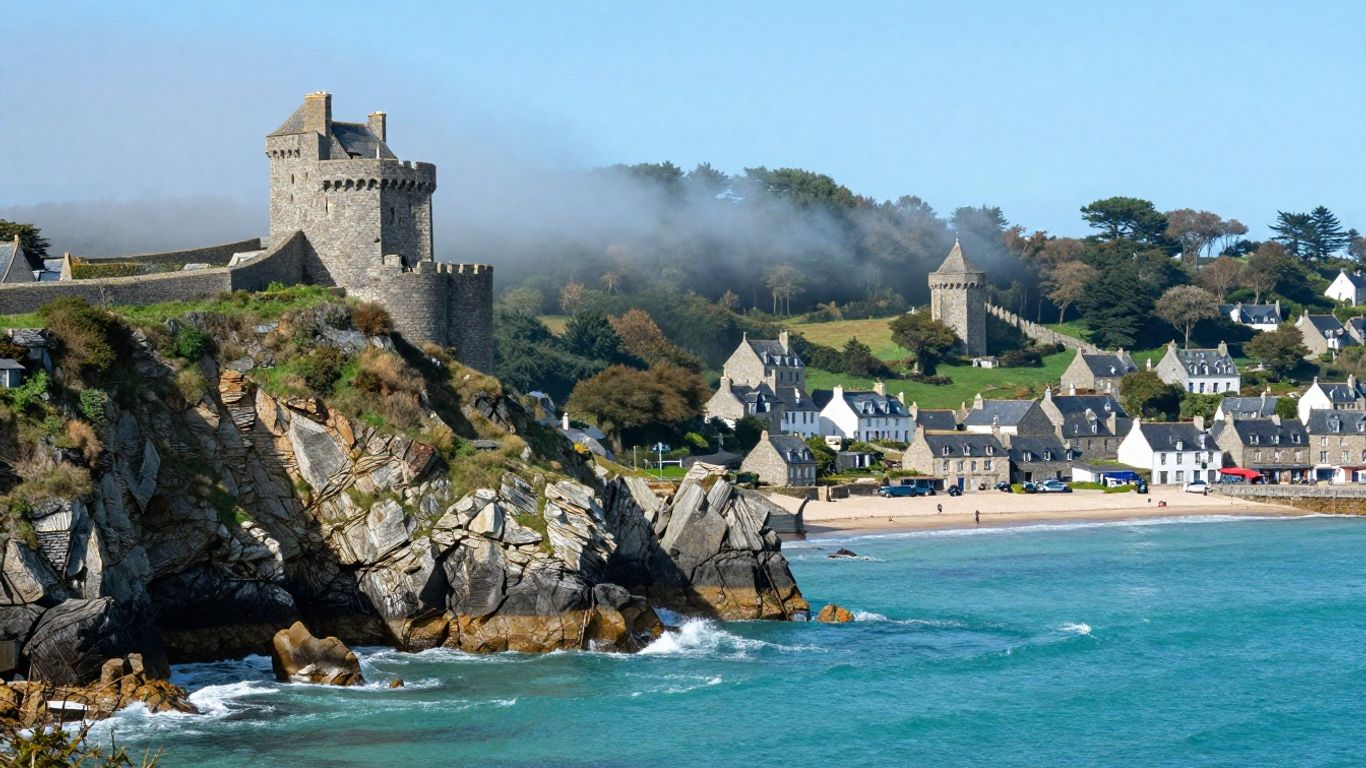
In the afternoon, ease into Quimper, the cultural heart of Brittany. The Odet river runs through it, crossed by flower-draped bridges, and the Cathedrale Saint-Corentin has a spire so fine it looks like lacework, which fits, given the region’s famous lace. Browse the food market, eat a proper galette, and stay the night.
If your legs are up for it, the short coastal loop around the Pointe du Raz headland is well worth doing before you drive on. Then Quimper makes a relaxed base for the night, with a handy train station if anyone in the group is peeling off home from here.
Day 6: The Standing Stones of Carnac and Quiberon
Head south for the strangest, most wonderful stop on this Brittany itinerary: the Carnac alignments. Thousands of standing stones, menhirs, marching across the fields in rows for miles, raised around 4,000 BC, long before Stonehenge. Wander the Kermario, Kerlescan and Le Manio sections (quieter early or late) and just let the mystery sit with you.
Nobody’s entirely sure why they’re here, which is half the magic. Then drive out onto the Quiberon Peninsula for a total change of pace: wild Atlantic surf on the Cote Sauvage, sheltered Brittany beaches on the calmer side, and a few more megaliths if you still can’t get enough stones.
Quick practical note: you can walk the Carnac alignments for free along the marked paths, though in high summer the fenced sections switch to guided tours only, to protect the stones. And if all that history leaves you wanting a swim, Carnac-Plage has proper sandy beaches a few minutes down the road.
Day 7: Vannes, the Gulf of Morbihan and Rochefort-en-Terre
Wind things down in Vannes, a gorgeous old port city wrapped in ramparts on the Gulf of Morbihan, a calm inland sea freckled with little islands. Wander the half-timbered streets, grab a last galette, maybe hop a boat out onto the gulf. On your way out, detour to Rochefort-en-Terre, regularly voted one of France’s prettiest villages, all flower boxes and crooked stone houses, and an easy place to lose an hour over a coffee. From here you’re well set to roll on toward Nantes or back to Paris. A week in Brittany is just long enough to fall for the place, and just short enough to leave you already plotting a return.
Got a day spare at the end? Nantes, technically just over the old border, makes a fun final stop, with its giant mechanical elephant at Les Machines de l’Ile and a genuinely good food scene. Otherwise, the drive back toward Paris rolls past Angers and its huge château if you want one last detour before real life resumes.
Doing Brittany as a Road Trip
Here’s the honest truth: this works best as a Brittany road trip. The trains are fine for hopping between the bigger towns, but the coves, the standing stones, the half-hidden villages? You’ll want a car for those. I book mine ahead (cheaper, and the big agencies sit at Rennes and Nantes airports), always take the full insurance, and never once regret it. If you love the idea of just following the coast, Brittany slots neatly into France’s best under-the-radar scenic drives.
- Book the rental early, especially for summer.
- Pick up at Rennes or Nantes airport, or in a bigger town.
- Take full insurance, and photograph any existing scratches first.
- Use a maps app: the lanes get tight and the signage is sparse.
Two more heads-up for driving here: the country lanes are narrow and hedge-lined, so ease off the gas, and the speed limits are posted and very much enforced. None of it’s hard, it just rewards taking your time, which is rather the point in Brittany. (A quick France travel and airports map guide is handy for sorting the wider logistics before you set off.)
Breton Food You Have to Try
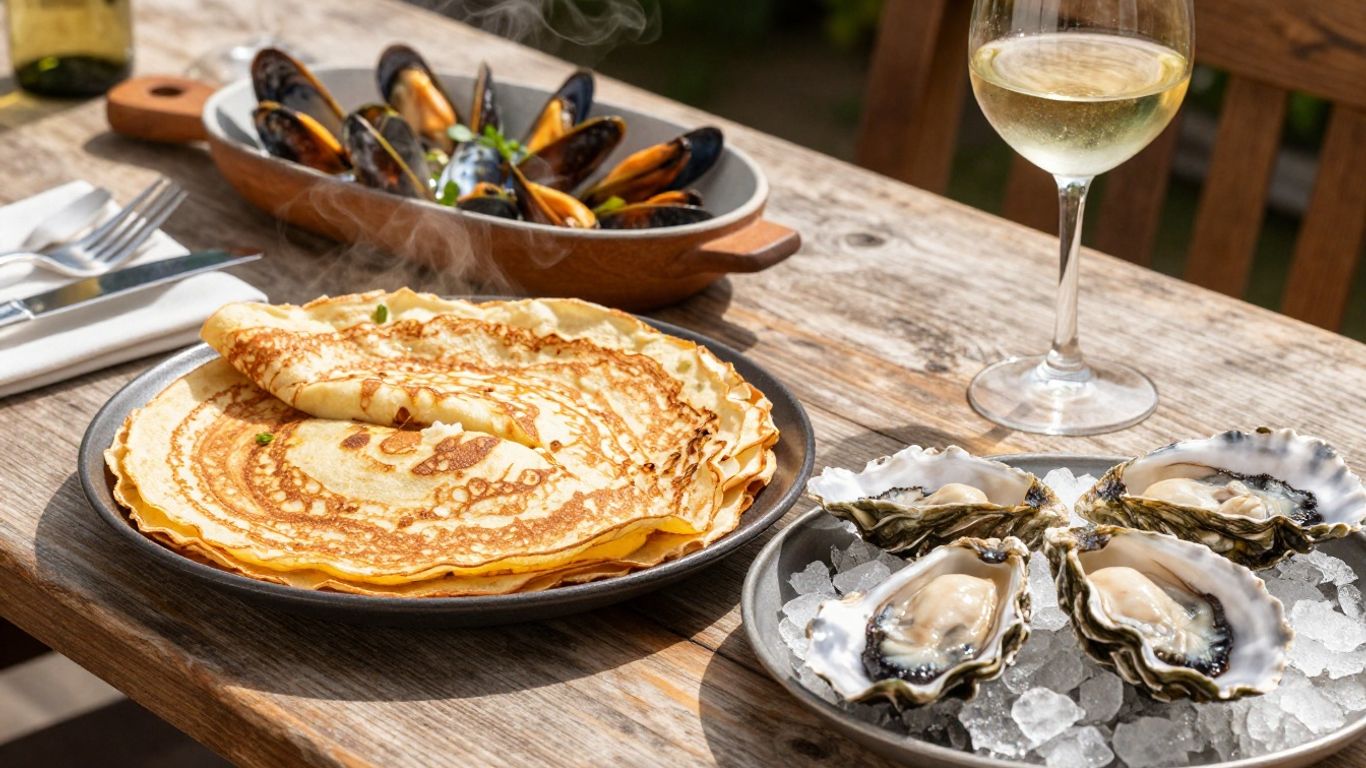
You will eat well. Galettes, the savoury buckwheat crepes, are the staple, usually folded around ham, cheese and a runny egg. Then sweet wheat-flour crepes for afters. On the coast, the Cancale oysters are about as fresh as it gets, eaten by the dozen with a glass of cider. And the one thing you cannot leave without trying: kouign-amann, a caramelised, buttery, faintly sinful Breton cake that quietly ruins all other cakes for you. Wash it down with local cider rather than wine. That’s the Breton way.
Best Time to Visit and Where to Base Yourself
Summer (July and August) is warmest and busiest. For the slow-travel feel, aim for late spring or September, warm enough, far quieter, kinder on the wallet. As for bases, resist moving every night. Two or three stops is plenty: Saint-Malo for the north, Quimper for the far west, Vannes for the south, and you’ve covered the whole route with minimal packing. Self-catering gites and family-run chambres d’hotes beat big hotels for atmosphere every time. It’s a wonderfully easy region for solo travellers too, safe, friendly, and quietly social.
Your Brittany Week, Sorted
And that’s a week in Brittany done properly: no rushing, no checklist anxiety, just granite coasts, ancient stones, and more butter than is strictly sensible. Treat this Brittany travel itinerary as a loose frame, not a rulebook. Linger an extra day wherever you click, skip whatever doesn’t grab you, and leave room for the village you stumble on by accident. That’s usually where the magic hides. Brittany has a real knack for slowing you down, so let it. Bon voyage.
Frequently Asked Questions
How many days do you need for a Brittany itinerary?
A week is the sweet spot, enough to pair the historic north with the wild west and the standing stones of the south without rushing. Short on time? Pick one half, north or south, and give it three or four days.
Is Brittany better as a road trip or by train?
Road trip, no contest. Trains link the bigger towns, but a Brittany road trip is the only way to reach the coves, the megaliths, and the little villages that make up the region. Rent a car and you can stop wherever a view grabs you.
What are the best things to do in Brittany in a week?
Walk the Saint-Malo ramparts, eat oysters at Cancale, wander medieval Dinan, hike the Pink Granite Coast, stand at the Pointe du Raz, and roam the Carnac alignments. That’s a strong week right there.
Are the beaches in Brittany worth it?
Definitely. The Brittany beaches range from sheltered sandy bays on the Quiberon and Crozon peninsulas to dramatic, rock-framed coves along the Pink Granite Coast. The water’s bracing, but the scenery more than makes up for it, and it’s all brilliant for families.
When’s the best time for a week in Brittany?
Summer’s warmest but busiest. For the slow-travel vibe, late spring and September are ideal: gentle weather, thinner crowds, better prices. Winter’s quiet and moody if you don’t mind a bit of rain.
What food should I try in Brittany?
Savoury buckwheat galettes, sweet crepes, fresh Cancale oysters, and the gloriously buttery kouign-amann. Drink local cider rather than wine while you’re at it.
Do I need to speak French?
It helps, but you’ll manage fine. English is common enough in hotels, restaurants and tourist spots, and a few polite French phrases go a long way with locals.
Where should I base myself in Brittany?
For a week, pick two or three bases: Saint-Malo or Dinan for the north, Quimper for the far west, and Vannes for the south. Day-tripping from a fixed base beats changing hotels every night.


