
French Beer and Cheese Pairing Guide: The Best Combinations That Actually Work

I recently decided to explore the world of French beer and cheese pairing, and honestly, it’s been a revelation. Forget what you think you know; this isn’t just about throwing some crackers and a random bottle on a plate. I learned that when you actually think about it, beer and cheese can be an amazing match. It’s like finding a hidden gem, and I’m excited to share what I’ve discovered about French beer cheese pairing.
Key Takeaways
- Beer is surprisingly forgiving when pairing with cheese, making it a great starting point for beginners. Unlike wine, beer is less likely to create truly unpleasant flavor clashes.
- Matching the intensity of your beer and cheese is super important. Think light beers with mild cheeses and bolder beers with stronger, aged cheeses so neither flavor gets lost.
- You can either mirror flavors (like citrusy notes in a beer with goat cheese) or go for contrasting tastes (like a sweet stout with a salty blue cheese) for exciting combinations.
- Considering regional pairings, where the beer and cheese come from the same area in France, can lead to harmonious tastes that reflect local traditions and terroir.
- Don’t forget the details! Serving temperature matters for both beer and cheese, and ultimately, personal preference is key, so don’t be afraid to experiment and find what you love.
Understanding The Fundamentals Of French Beer And Cheese Pairing
Beer: The Easiest Beverage For Cheese Pairing
When I first started thinking about matching beer with cheese, it felt a bit intimidating. You know how people talk about all these elaborate rules with wine and cheese, and I just figured beer would be just as picky, somehow. But honestly, beer is way more forgiving. It’s like the friendly neighbor of beverages when it comes to cheese. You can grab a few different cheeses and a handful of beers, and chances are, you’ll find some combinations that just click. It’s a much lower-stakes way to start exploring, and you’re less likely to end up with a pairing that tastes just plain wrong. It’s more about finding something that’s just okay, or something that’s surprisingly great.
The Shared Origins Of Beer And Cheese
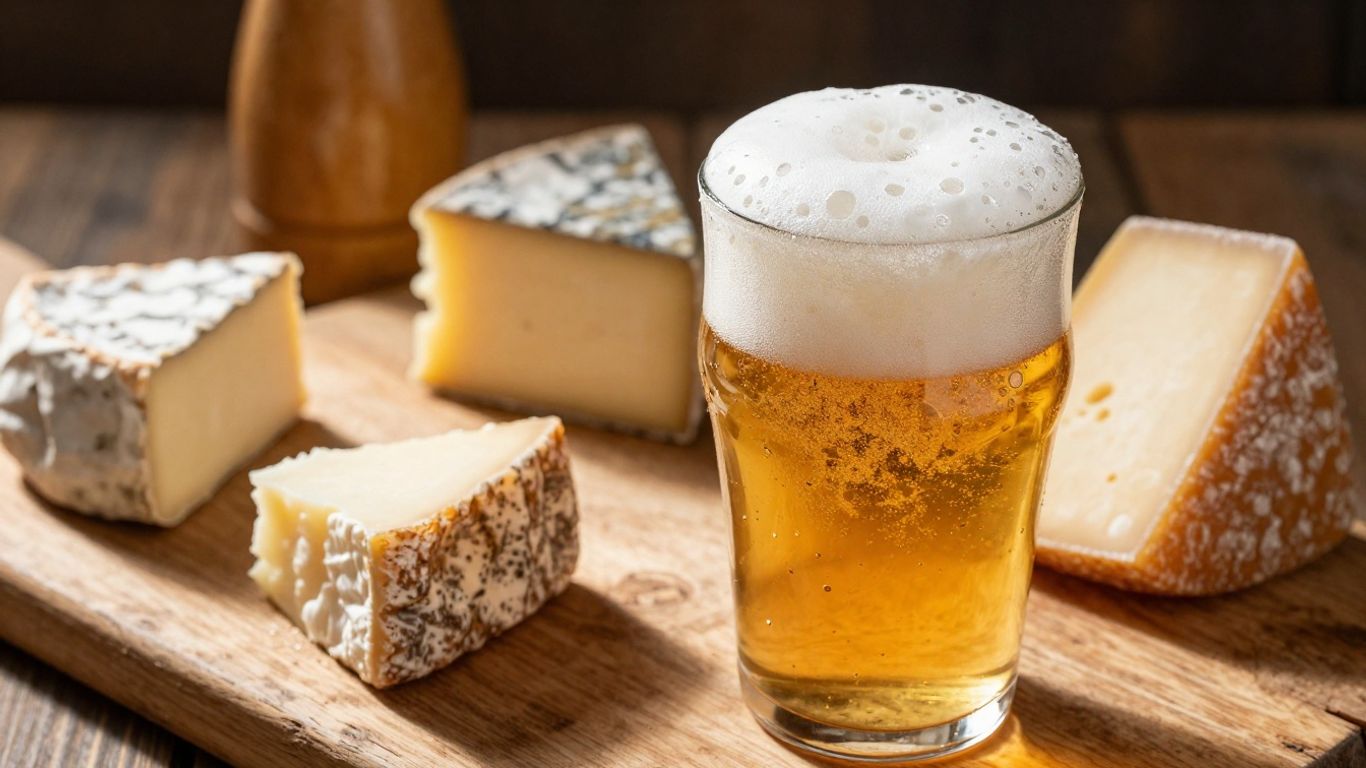
It actually makes a lot of sense when you stop and think about it. Like… beer and cheese both kinda trace back to agriculture, especially to grains, and milk that comes from grass-eating animals. In a sense, barley and wheat, those grains that make up the base of most beers, are really only a form of grass. The milk from dairy animals (cows, sheep and goats) is turned into cheese. These animals graze primarily on grass which ties these two products together. Therefore, both milk and grain can originate on the same farm, and because of that, they usually share that same gentle, natural taste. It’s like they grew up in the same neighborhood, so they basically get along.
Why Beer Is More Forgiving Than Wine
Wine can be a bit of a diva when it comes to cheese, I mean really. Sometimes those acids, or tannins in wine, start rubbing the wrong way with the fats and proteins in cheese, and then you get these odd metallic or just plainly bitter flavors. It feels like this delicate little dance, and honestly one wrong step, and the whole thing sort of falls apart.
Beer though… It’s way more adaptable. The carbonation in beer can sort of scrub your palate clean between bites of cheese, so each new taste feels fresher, cleaner. And there’s more than that, the flavors you can find in beer— from light and crisp to dark and roasty— give you a broader playground. So it’s easier to snag a pairing that works well, without running into the same kind of unpleasant clashes you might notice with wine. Beer’s versatility is basically its superpower in the cheese pairing world.
When you’re starting out, don’t overthink it. Grab a few different types of cheese and a few different beers. Try them together. See what you like. You’ll learn more from your own taste buds than from any rulebook.
Here’s a simple way to start thinking about the intensity:
- Mild Cheeses: Think fresh goat cheese (chèvre), mozzarella, or a young, mild cheddar.
- Medium Cheeses: Consider Gruyère, a semi-firm Gouda, or a creamy Brie.
- Bold Cheeses: Look for aged cheddars, blues like Roquefort, or a strong, washed-rind cheese.
And for beers:
- Light Beers: Pilsners, lagers, wheat beers, or crisp Saisons.
- Medium Beers: Pale ales, IPAs, Belgian dubbels, or amber ales.
- Robust Beers: Stouts, porters, barleywines, or strong Belgian tripels.
Mastering The Art Of Intensity In Pairings
When I first started poking around beer and cheese, I kind of ended up feeling a little lost. It seemed like there were too many options, and I wasn’t certain where to start. The main snag, I learned pretty quick, is making sure one doesn’t go and completely overpower the other. Kind of like trying to carry on a conversation where one person is basically shouting, it just won’t flow.
Think of cheese on a scale, from the mildest, freshest ones to the really strong, aged varieties with bold flavors. Beer has a similar spectrum. You’ve got your light, crisp beers on one end, and then your super hoppy IPAs or smoky porters on the other. If I pair a delicate fresh cheese with a really heavy beer, I’ll barely taste the cheese. And on the flip side, a light wheat beer just gets lost next to a powerful blue cheese.
Matching Beer And Cheese Intensity Levels
So, how do I actually do this? I usually start by considering the intensity. It’s a simple rule, but it makes a huge difference. The goal is to find a beer and a cheese that are at a similar level of flavor intensity.
Here’s a simple beer pairing chart I keep in mind:
- Light Beers with Mild Cheeses: Think of a crisp Pilsner or a light Gose. These are great with fresh cheeses like a simple chèvre or a mild, buttery semi-firm cheese. They don’t fight for attention and let each other shine.
- Medium-Bodied Beers with Medium Cheeses: A malty Amber Ale or a Belgian Dubbel can stand up to cheeses with a bit more character, such as a young cheddar or a semi-hard cheese with nutty notes.
- Robust Beers with Bold Cheeses: This is when the fun begins. A deep, dark Stout or a robust Barleywine, with their higher strength and complex flavors, can be nicely complemented by a really spicy blues cheese or a strong cheddar that has been aged quite a lot.
Beer and cheese have, kind of, shared beginnings; both rising from grains and milk, respectively. So it’s not surprising that the flavors tend to match up in a natural way. Because of this, beer can be a surprisingly forgiving match for cheese, while wine, well, can sometimes clash.
Light Beers With Mild Cheeses
When I reach for a light beer, I’m usually kinda thinking about that refreshing but easy drinking vibe. Like something light and breezy, you know. Beers such as Kolsch, Pilsner, or even a light Saison they all kinda fit that bill. They tend to show delicate flavors, not the kind that really shove past a cheese. So for those beers I end up wanting cheeses that are just as gentle. Fresh varieties, like a simple goat cheese or a mild creamy Brie, they really do the job. And honestly, a young buttery cheese can work too, in the same quiet way. It’s mostly balanced, where neither the beer nor the cheese is trying too hard or acting like the main character.
Robust Beers With Bold Cheeses
On the other end of the spectrum are the big, bold beers. I’m kinda talking about Imperial Stouts, Barleywines, or Double IPAs. These beers have complex, really intense flavors and often a higher alcohol content too, so they can stand up to cheeses that are equally strong. A sharp, aged cheddar, a kind of funky washed-rind cheese, or even a classic blue cheese like Stilton works great, you know.
The beer’s richness, and this extra depth can match the cheese’s powerful character and then you get this satisfying pairing. Honestly it feels a bit like a heavyweight boxing match for your taste buds, but in the best possible way, too. However, if you’re taking a beer tour of Brittany, you might be in for a bit of a surprise as you’ll stumble upon some full-flavored and dark types which would go great with a strong and well-developed cheese such as strong cheddar or some other.
Exploring Flavor Profiles For Complementary Pairings
Beyond just matching intensity, I find the real magic happens when I start thinking about the actual flavors in both the beer and the cheese. It’s like finding a secret language between them.
Mirroring Flavors: Citrus With Goat Cheese
Many times, just playing off similar flavors is the simplest and the easiest way. For example, I have observed that a bright, zesty goat cheese with just a little tang is really singing a good duet when served with a beer, one that has some citrus notes.
Think of a Belgian Witbier with coriander and orange peel little hints, or maybe a crisp Saison. Somehow the beer’s mild, citrus leaning vibe just… it amplifies the cheese’s own lively notes, so everything tastes even better at once. It’s a basic thought, but honestly it works so well.
Nutty Notes And Malty Beers
In stark contrast, when I’m really into a cheese that has a nutty flavor such as an aged Gruyère or Comté I tend to match it with a beer that has a strong malt foundation. Beers such as Bock or Amber Ale that are noted for their tastes of toast, caramel, and, of course, nuts, become kind of a perfect pairing. The sweet, malt character in the beer is a natural counterpart to the nuts and sweet qualities in the cheese, so the overall experience is something like having a deep, comforting, and rich one. You get the impression that these two ingredients were basically put together in the first place.
Funky Washed Rinds With Farmhouse Ales
It’s here the excitement begins, and I just love every bit of it. Cheeses with washed rind that are usually pungent and have somewhat slimy outside, though, can be a real hassle. They just feel… well, harder to handle, in a way. But I’ve found that a rustic Farmhouse Ale or a Saison is often the perfect partner. These beers, with their often complex, earthy, and sometimes even slightly funky yeast characteristics, can stand up to and even complement the bold flavors of a washed rind. It’s a pairing that respects the intensity of both components.
When I’m pairing flavors I kinda try to picture what the animal was eating, not just the dairy itself. Like if the cheese has that grassy sort of feel, I’ll hunt for a beer with a herbal edge, or maybe a grassy hop vibe, something in that neighborhood. And if the cheese tastes kinda rich and buttery, then a malty beer often evens it out. It’s really about catching those little, subtle links between things, even when they’re not super obvious at first.
Here’s a quick rundown of some complementary flavor ideas:
- Citrusy Beers with Tangy Goat Cheeses
- Malty Beers (Bocks, Ambers) with Nutty, Aged Cheeses (Gruyère, Comté)
- Farmhouse Ales/Saisons with Washed Rind Cheeses
- Fruity Beers (Kriek, Gose) with Mild, Creamy Cheeses
It’s basically all about hunting down those echoes of flavor, like when you catch a shared fruitiness, or that same kind of nutty note, and sometimes even an almost familiar earthy edge. This whole pairing vibe, where I pay attention to what’s actually in the beer and what’s in the cheese, kinda has shaken up my palate, in a good way, to try other combinations. And if you want to dig in a bit more on particular beer styles, looking up info on Bière de Garde can give you some solid glimpses into the malty complexities too.
The Excitement Of Contrasting Flavors
While mirroring flavors is a solid strategy, sometimes the real magic happens when you throw caution to the wind and pair things that seem totally opposite to each other, like you would not expect in the first place. I’ve found that these unexpected combinations can really wake up your palate and lead to some genuinely delightful discoveries.
Sweet Stouts And Salty Blues
This is kinda a classic for a reason, you know. The intense, often sweet, and rich nature of a stout or porter sort of creates a nice counterpoint to that sharp salty punch that blue cheese brings, which is honestly a pairing you don’t get tired of. Picture dark chocolate and coffee-flavored creamy stout next to a crumbly, piquant Roquefort. The sweetness of the beer melts the salty notes on the tongue, but the sourness of the cheese prevents the whole thing from getting. It’s a dance of opposites that just works.
Fruit-Forward Beers With Tangy Cheeses
When I’m kind of in the mood for something a bit more bright, I usually go after fruit-forward beers. Like a kriek, (yeah, a Belgian cherry ale ) or a gose that has fruity notes can be surprisingly good with tangy cheeses. You might automatically pair them with something mild but I’ve had really solid results with cheeses that have a bit of a bite, think a sharp feta, or even a young tangy goat cheese. The fruit in the beer sort of works with any low-key fruitiness in the cheese, and the beer’s acidity can hold its ground against the cheese’s tang. Overall it feels refreshing, almost a little polished, but not overly complicated.
Unexpected Combinations That Delight
Honestly, the best bit about poking around beer and cheese is this kind of electric joy of accidentally finding something you never would have guessed. I recall trying a saison, paired with a little funky washed rind cheese, and it was kind of a revelation. The earthy barnyard vibes from the cheese felt like they helped bring up the peppery spice in the saison, and together they made this complicated flavor story that just… kept me drifting back for another. Don’t be afraid to mess around. You might just discover your new favorite match, without even meaning to.
The key is not to be afraid to try something new. Sometimes the most odd pairings, make the most memorable experiences, you know? Start with a beer you already enjoy and a cheese that sort of draws you in, then just see where the flavors end up taking you, in the end.
Here are a few more ideas to get you started:
- Imperial Stout with Triple Crème Cheese: The richness of the stout meets the buttery decadence of a triple crème. It’s pure indulgence.
- Barleywine with Aged Cheddar: The malty sweetness and oak notes of a barleywine harmonize beautifully with the sharp, nutty character of an aged cheddar.
- Fruity Lambic with Mild Goat Cheese: A lighter, fruitier lambic can offer a delicate sweetness that balances the earthy tang of a young goat cheese.
Regional Pairings And Terroir Considerations
When I first started poking around French beer and cheese, I kinda went straight for the big, well-known pairings. But then I kept wondering where all of that stuff really comes from. Like, if you look at the pairings from the same region, you end up learning a lot about the local terrain and the old habits people follow there. Kinda like sampling a small fragment of France, one bite at a time.
French Beer and Cheese From The Same Region
This is where it gets kinda real interesting for me. Think about it: the same soil, same climate, same water; all those parts matter a lot, for the barley used for beer and also for the pastures where cows or goats graze for cheese. It’s this idea called terroir, and yeah it’s a big deal in French food and drink.
So when you match a beer with a cheese from the same area, you tend to notice this kind of balanced blend, like it was quietly building for centuries. Like, for example, a Saison brewed in the North of France might have that rustic character, you know, and it just works when you pair it with a local farmhouse cheese from that very region. It’s one of those links you can really taste, and not in a vague way either.
How Terroir Influences Flavor
Terroir isn’t just some fancy term, it actually kind of shapes what you end up tasting. Like, the minerals in the ground can change how the grains behave in beer so you get this genuinely earthy vibe. And it’s not only that, the grasses, and the little wildflowers over in a pasture, they can quietly shift the milk for cheese, leaving a more floral or herbaceous hint, depending on the spot. I’ve noticed that beers with a touch of maltiness tend to work nicely with cheeses that lean nutty, but the link feels clearest when they come from the same general place.
It’s less about matching flavors in a rigid way, more about catching those shared environmental murmurs, both in the glass and on the plate, which makes the pairing feel; oddly natural. Also, the French craft beer scene is really starting to buy into this mindset, brewers are messing with locally sourced ingredients, and keeping traditional flavors in the mix. If you go looking for quality craft beer, you often stumble into these regional treasures right along the way.
Exploring Local Traditions Through Pairings
Beyond just matching flavors, food, and beer pairing through regional traditions is kind of a way to reach local history. I mean, a lot of French breweries and cheese makers are really rooted into their communities and the land, in a quiet almost stubborn way. When I try French craft beer and cheese from, say, Normandy I end up feeling like I’m getting a sense of that exact place, not only the surface notes. It’s not just about taste, it’s about the story sitting underneath it. Here are a few ideas to get you started:
- Brittany: Think about a crisp, malty beer from Brittany paired with a salty, firm cheese like a Comté that might also be aged in the region.
- The Alps: A robust, slightly sweet beer could be a great match for a strong, nutty cheese from the Alpine regions.
- Northern France: Consider a traditional Bière de Garde paired with a creamy, bloomy-rind cheese from the same region.
The beauty in these regional pairings is that they often feel weirdly natural, like it was always supposed to happen. I mean it’s kinda like the beer and the cheese were destined to be together, formed by the same land and the same little traditions, right. And I’ve noticed, when I zero in on a specific French region, the beer and cheese options get a lot clearer, plus more satisfying too.
Tips For Your Own French Beer And Cheese Tasting
So, you’ve read all about the amazing ways beer and cheese pairing can bring French beer and cheese together. Now, I bet you’re kinda itching to test some of this on your own. That’s totally normal, I mean, really, who wouldn’t be. Hosting your own tasting is a really great way to dig into these pairings and slowly figure out what you like the most, like what actually clicks. It’s not as hard as it first sounds, and if I’m being honest it’s a whole lot of fun, too.
Starting Your Tasting Journey
When I first started doing this I felt kind of overwhelmed by all the choices, you know. My advice, keep it plain just to start. Pick a couple of cheeses and maybe just a few different beers. Don’t try to do everything at once, it’s easy to get tangled up. It’s usually better to have a handful of well picked pairings, then a giant spread that makes you confused. Maybe begin with something mild and creamy, paired with a lighter beer, and then later switch it up with a slightly stronger cheese and a more robust brew. That way you can actually taste the differences, without your palate getting worn out too fast.
The Importance Of Serving Temperature
This is something I learned the hard way, honestly. The serving temperature makes a bigger difference then you might guess. With cheese, you really want it at room temperature so the taste notes can come through, and not stay kind of muted. Just take it out of the fridge about an hour before you plan on tasting, that part matters.
With beer though, it gets a little more all over the place. Lighter styles, like a crisp Saison, are usually better chilled more, maybe around 40-45°F (4-7°C). Meanwhile, darker and richer beers, like a strong Belgian Dark Strong Ale, do okay at a slightly warmer level, around 50-55°F (10-13°C) so the layered malt character can shine, instead of feeling flat. When you get it right you start to notice the whole range, you know, across both the beer and the cheese.
Embracing Experimentation And Personal Preference
Ultimately, the best pairing is the one you end up enjoying the most. Sure there are classic combos and these kinda general guidelines but don’t be afraid to sort of go off book. I’ve had a few unexpectedly strong pairings that weren’t anywhere near an “official” list, either. Like maybe you really like a particular type of cheese, then try it with a beer you’d never normally connect with it. Just do it. Also keep a quick track of what you try, what you ended up liking, and what didn’t really land. This is how you build your own personal guide to French beer and cheese.
The goal of beer and cheese pairing isn’t to find a single “perfect” combination, but to discover a range of flavors that bring you joy and introduce you to new taste sensations. Trust your own taste buds; they are your best guide in this delicious exploration.
Here’s a little beer pairing chart to get you started thinking about temperature:
| Beer Style | Serving Temperature (°F) | Serving Temperature (°C) |
| Light Lagers & Pilsners | 40-45°F | 4-7°C |
| Wheat Beers & Saisons | 40-45°F | 4-7°C |
| IPAs & Pale Ales | 45-50°F | 7-10°C |
| Belgian Ales & Trappist | 45-55°F | 7-13°C |
| Stouts & Porters | 50-55°F | 10-13°C |
| Barleywines | 55-60°F | 13-16°C |
Wrapping Up My French Beer and Cheese Journey
So, after all this exploring, I’ve found that pairing French beer and cheese isn’t some impossible puzzle. It’s actually pretty fun, and honestly, beer is way more forgiving than I thought when it comes to cheese. I mean, who knew beer and cheese basically come from the same grass family? It makes sense why they often work so well together. My biggest takeaway? Don’t be afraid to try things out. Start with lighter beers and cheeses and work your way up, or just go for contrasting flavors if that sounds more interesting. You might be surprised by what you discover. I know I was. So grab a few different cheeses, pick up some French beers, and have your own tasting at home. You might just find your new favorite combination.
Frequently Asked Questions
Why is beer considered easier to pair with cheese than wine?
I find beer to be way more forgiving when pairing with cheese. Both beer and cheese come from grains and milk, which share similar earthy roots. Plus, beer’s natural bubbles help cleanse your palate, making it easier to enjoy each bite and sip without flavors clashing, unlike wine, which can sometimes be trickier.
How do I match the intensity of beer and cheese?
It’s all about balance! Think of cheese on a scale from mild to strong. Light, fresh cheeses like goat cheese go best with light, crisp beers like pilsners. For really strong, aged cheeses, you’ll want a bold beer, like a dark stout or a hoppy IPA, to stand up to those big flavors.
Can you give me an example of mirroring flavors when pairing?
Absolutely! If you have a goat cheese that has a bit of a citrusy tang, I’d suggest pairing it with a beer that also has citrus notes, like a Belgian Witbier or a sour ale. It’s like finding two things that are already friends and bringing them together.
What’s an example of a contrasting flavor pairing that works?
One of my favorite surprising combos is a sweet, rich stout with a salty, pungent blue cheese. The sweetness of the stout cuts through the saltiness of the blue, and the boldness of both flavors creates a really exciting taste experience. It’s like a sweet and salty candy bar, but way more sophisticated!
Should I try to pair beer and cheese from the same region?
Yes, exploring regional pairings is a fantastic idea! Just like wine reflects its ‘terroir’ (the land it comes from), so do many cheeses and craft beers. Pairing a beer and cheese made in the same area can give you a real taste of local traditions and flavors that grew up together.
What’s the best way to start my own beer and cheese tasting?
My best advice is to just dive in and experiment! Start with simpler pairings, maybe a mild cheese and a light beer, and work your way up. Pay attention to serving temperatures – chilled for light beers, slightly warmer for darker ones. Most importantly, trust your taste buds and have fun discovering what you love!