

The Camargue: A Journey Through France’s Most Untamed Landscape

Thinking about going somewhere in the south of France? Hold on, forget the usual spots for a second and, like, picture it: huge open lands, wetland regions spreading out, and the sky sort of packed with pink flamingos, actually not, you know, just one or two. That’s the Camargue. It’s this really unique area where a river meets the sea, creating a landscape that feels almost wild, like a different country. You’ve got these famous white horses running around, black bulls in the fields, and a whole lot of nature to explore. It’s a bit cowboy, a bit of a birdwatcher’s dream, and definitely a place that sticks with you.
Key Takeaways
- Explore the Camargue’s unique delta landscape, a mix of wetlands, salt pans, and plains.
- See iconic wildlife like pink flamingos, white horses, and black bulls in their natural habitat.
- Discover natural reserves such as Parc Naturel Régional de Camargue and La Capelière.
- Experience the region by horseback, riding with the local ‘gardians’.
- Visit Saintes-Maries-de-la-Mer for its history, culture, and local food.
Discovering the Camargue’s Unique Landscape
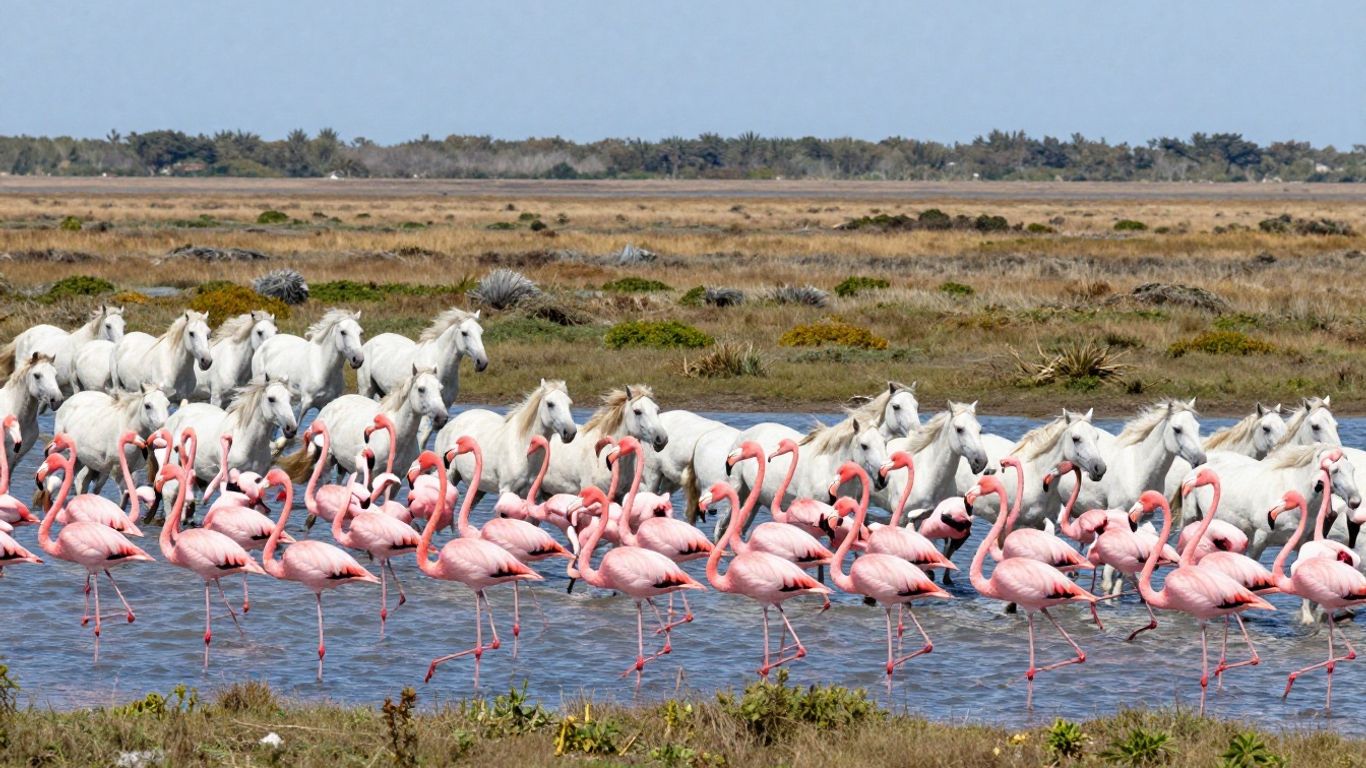
When I first arrived in the Camargue, it felt a bit like stepping onto another planet, you know? It’s this enormous, untamed delta where the Rhône River kind of mixes with the Mediterranean Sea, and honestly, The Camargue France, is different from anywhere else in France. Forget the neatly arranged vineyards or the crowded city noise; here it’s all about open ground, glinting salt beds, and this raw, unrestrained charm that kind of lodges in your mind. The scenery is made by water plus wind, and it’s also where you’ll spot some really iconic moments and sights.
A Wild Delta Between River and Sea
The Camargue France really is, essentially a giant wetland—kind of a natural park that’s been made, carved out by the Rhône as it heads toward the sea. Because of that you get this wild blend of freshwater lagoons, salty marshes, and stretches of sandy shore. It’s a spot where the land seems like it’s always doing something, always moving, shaped by both the tide rhythms and the river current. You can sit there for hours just watching the water, the light shifting over the surface, and somehow still feel the massive scale of everything, it’s almost hard to put into words. Honestly it’s a bit humbling in that way. If you want another face of France, away from the usual tourist paths, then this area gives a genuinely grounded experience.
Wetlands, Salt Pans, and Vast Plains
What struck me most were the sheer expanses. You have these enormous wetlands, teeming with life, and then suddenly, you’re looking at vast, flat plains that stretch to the horizon. And the salt pans! They’re honestly incredible, especially when the sun hits them, and the water turns into these dazzling pink and white mirrors, like wow.
It’s a photographer’s dream, sort of, even if I mostly just stood there, trying to take in one of the most spectacular wild landscapes in France. The air too, it often carries the scent of salt and wild herbs, a unique kind of perfume for the region, not sure how else to say it. It’s a working landscape too within the Camargue natural park, with salt harvesting still happening in some areas, creating those striking white mountains of salt.
A Haven for Birdwatchers and Wildlife
This is where the Camargue truly shines. Because of its unique environment, it’s a magnet for birds. I’m not a hardcore birdwatcher, but even I was amazed by the sheer number and variety of species. You’ll see flamingos everywhere, of course, their pink plumage a vibrant contrast to the muted landscape.
But there are, so many others also, herons, egrets, avocets, and countless migratory birds that use this delta as a necessary stopover, like a quiet hinge in the journey. It feels like you’re connected to nature, somehow, where the rhythm of the seasons decides the flow of life. For birdlife the best moment to go is often spring and autumn, when migration is at a full tilt peak really, you can almost sense it.
Where to Stay:
If you really want that immersive feeling, you might think about staying in a traditional mas, (basically a farmhouse) or in a small gîte somewhere inside the park area. A lot of these places sit in quiet rural spots, so it becomes this calm little base, where you can roam around the wetlands and watch wildlife, sometimes even from your doorstep. Saintes-Maries-de-la-Mer is another popular option, you’ll find hotels and guesthouses there, but it can be a bit more lively, more busy in general.
Iconic Wildlife of the Camargue
When I first went to the Camargue, I didn’t know what to expect, besides those well known pink birds. But honestly, the camargue wildlife here, it is something else. It really feels like a totally different place, almost like you’re stepping back in time, or into some old weathered memory.
The Elegant Pink Flamingo
You can’t really talk about the Camargue without at least mentioning the flamingos. They’re everywhere, mostly in the salt pans and in those shallow lagoons too. The first time you spot them, and not just one, but an entire flock, it’s kind of mind-blowing. They seem to stay there, so still, and then—suddenly, they all lift off, like a wave of pink set against the blue sky. Honestly it’s one of those sights I won’t forget, not ever.
- Best viewing spots: Parc Ornithologique de Pont de Gau is a great place to start. They have boardwalks that get you close without disturbing the birds. The Étang de Vaccarès is another huge lagoon where you’ll see them.
- When to see them: They are present year-round, but numbers can swell during migration seasons. I found late spring and early autumn to be particularly good.
- What they eat: They filter tiny crustaceans and algae from the water, which is what gives them their distinctive pink color. Pretty neat, right?
Galloping White Horses
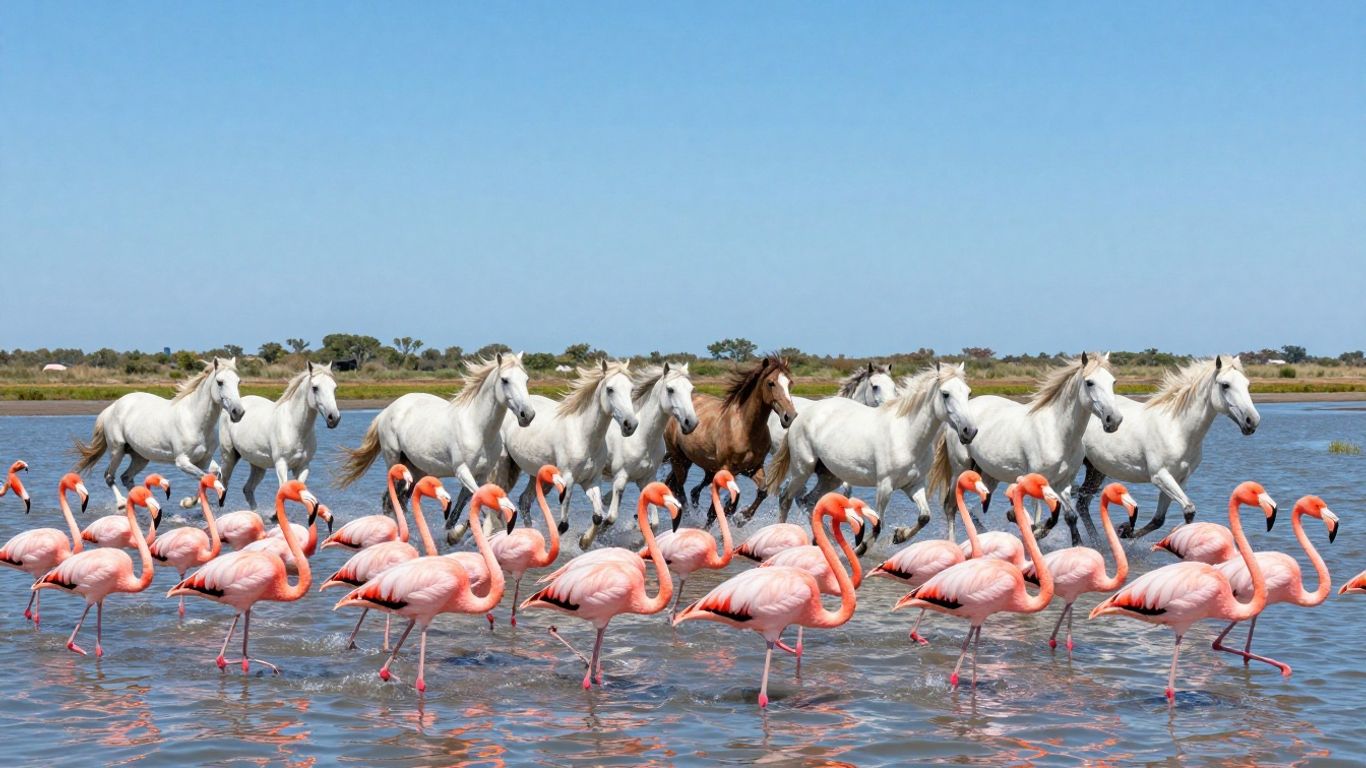
Then there are the white horses. They are not just any horses no, they’re Camargue horses, and they’re famous for being sturdy, basically built for the wet marshy ground. You’ll spot them a lot alongside the gardians, the local cowboys who help herd the bulls, not really as a show but more like daily life. When they move over the open flatlands you can see water splashing around their legs, it’s kind of a standard Camargue scene. I also went on a horseback ride myself, and honestly that was an incredible way to read the landscape from another angle. It felt wild, free, and a bit untamed too.
Riding through the shallow waters as the sun began to set, with the silhouettes of horses against the horizon was, truly magical, like a small spell or something. It’s in moments like these that make travel so special, you know.
Majestic Black Bulls
And yeah, the black bulls, the ones people always talk about. These famous Camargue bulls, raised for the local course camarguaise events, they’re kinda a big deal. Out in their pastures they look really powerful, super imposing too, like they’re holding their ground on purpose. Now sure, at first glance they can feel intimidating… but they’re still a vital part of the region’s identity and the whole landscape. You’ll spot them grazing in huge herds across the plains. They just keep showing up, like a constant reminder of the area’s rugged, untamed nature, you know. It’s sort of like the American West, but, with a distinctly French flair about it.
Where to Stay:
Lots of visitors kind of base themselves in Saintes-Maries-de-la-Mer. It’s a pretty charming coastal town, with a decent range of hotels and guesthouses too. If you want something a bit more immersive, try searching out manades (ranches) that also provide accommodation. Then you end up right in the middle of the countryside, close to where the horses and bulls hang out, more or less all day.
I stayed at a small place just outside of town, and honestly, waking up to the marsh sounds was fantastic, like very calming but also alive. You can come across stays from straightforward B&Bs to more upscale hotels; it really depends on your budget and the mood you’re going for. Booking ahead is a good idea, especially when it’s peak season, because places go quickly.
Exploring the Camargue’s Natural Reserves
When I first visited the Camargue, I was kinda struck by how much of the region is dedicated to protecting its wild core. It’s not just a pretty landscape really, it’s more like a living and breathing ecosystem, it needs careful management, all the time. The natural reserves are where you really get a sense of this.
Parc Naturel Régional de Camargue
This is the big one, the main protected zone that covers a huge chunk of the Camargue. It’s a place where the Camargue natural park feels more or less untamed for real. When you’re driving through, you notice those vast flat spaces, lined with shallow lagoons and reed beds, kind of endless. It’s pretty straightforward to spot the iconic white horses here, they’re often grazing in groups, and the black bulls are there as well, looking totally comfortable in the wild. The sheer size of the park is impressive, and honestly it’s the best place to really get a sense of the Camargue’s particular habitat, the whole vibe.
I spent a good chunk of a day just driving around the park’s periphery and stopping at designated viewpoints. You can see so many different types of birds just from the roadside, especially around the water bodies. It’s a place that really makes you appreciate the importance of conservation.
- Wildlife Spotting: Keep an eye out for flamingos, egrets, herons, and various waterfowl.
- Photography: The light here is incredible, especially at sunrise and sunset, casting long shadows across the plains.
- Understanding the Ecosystem: The park’s information points offer insights into the delicate balance of the wetlands.
- Where to Stay: While there are no accommodations directly within the park itself, you’ll find plenty of options in nearby towns like Arles or Saintes-Maries-de-la-Mer, which serve as excellent bases for exploring the park.
La Capelière Nature Centre
This was a real highlight for me. La Capelière is a fantastic spot for getting up close to wildlife, particularly birds.
It’s kind of set up with places to watch and paths that kind of drift through the wetlands, not in a straight line or anything. I remember walking along those raised boards, sort of feeling like I was right in the middle of the marsh, without messing it up, or disturbing anything. It is really peaceful, almost quiet in a way that makes you breathe slower.
They have a few hides where you can sit, sort of quietly, and keep an eye on the birds without them noticing, it’s almost odd how calm it feels. I walked in and saw so many flamingos here , their pink plumage is a strong contrast to the more muted greens and browns of the reeds. And yeah, it’s also a really good spot to pick up more knowledge about the different bird species, and the conservation work that’s being carried out.
- Bird Hides: Strategically placed for optimal viewing of flamingos and other water birds.
- Educational Displays: Learn about the flora and fauna of the Camargue.
- Walking Trails: Gentle paths suitable for all fitness levels.
- Where to Stay: Similar to the main park, staying in Saintes-Maries-de-la-Mer or Aigues-Mortes is your best bet. La Capelière is a relatively short drive from these towns.
Étang de Vaccarès Birdwatching
The Étang de Vaccarès is sort of the biggest lagoon in the Camargue, and it really pulls in birdwatchers too. It’s this enormous stretch of water, and when I went there, it felt alive, like fully buzzing. You can spot massive groups of flamingos, sometimes they seem to go on, almost to the horizon, and it’s honestly a lot to take in at first. I mean it’s a full-on spectacle, really.
There are several points around the lagoon where you can stop and observe. The sheer number of birds is astounding. It’s a bit more open and exposed than La Capelière, so on a windy day, it can be quite bracing, but the views are spectacular. It really drives home how important these wetlands are as stopovers and breeding grounds for so many species.
The Étang de Vaccarès is a vital piece of the Camargue natural inheritance, kind of a broad wetland area, it shelters this astonishing range of birdlife. With waters that stay shallow and reed beds that sit around them, it becomes an ideal living space for thousands of migratory, as well as local birds. So yeah it is really worth a visit, if you want to see wildlife up close or you’re curious about bird watching in general.
- Best Time for Birdwatching: Early morning and late afternoon often offer the most activity.
- What to Bring: Binoculars are a must, and a good zoom lens for your camera will be very useful.
- Respect Wildlife: Maintain a safe distance and avoid disturbing the birds.
- Where to Stay: The closest significant town is Saintes-Maries-de-la-Mer. You can also find some rural gîtes or farm stays in the vicinity, offering a more immersive experience.
Experiencing the Camargue on Horseback
If there’s one thing you absolutely must do when you visit the Camargue, it’s to get on a horse. Seriously, forget the car for a bit. The landscape here, this wild delta between river and sea, is just made for exploring on horseback. It’s how the locals, the famous gardians, have always done it, and it gives you a connection to the land you just can’t get any other way.
Riding with the Gardians
They’re not simply any horses; no, they’re those iconic white Camargue horses. Smaller than you might first assume, they’re also really solid and well-suited to this kind of watery terrain. When you ride out with the gardians, it’s not only about going for a trot; it’s more like getting a quick look into a whole way of life that’s stayed for centuries. They know these lands in a hands-on way, steering you through spots you’d probably never stumble upon by yourself. And the whole sensation of riding right alongside them, wind in your hair, while the huge Camargue opens up ahead. It’s genuinely unforgettable.
Treks Across Salt Flats and Reed Beds
Most spots offer treks that go on for a few hours, or you can book a whole day if you’re really keen, kind of thing. I went with a half-day ride and honestly it felt just right. We rode out from a small ranch near Saintes-Maries-de-la-Mer, and within minutes we were on the open plains. The horses are really calm, they seem used to people, even when you’ve never ridden a thing before.
We went through shallow water, past fields of tall reeds, and even out onto some of the salt flats. Seeing the landscape change from marshland to the stark white of the salt pans from the saddle is something else. Keep an eye out for flamingos taking flight – it’s a magical sight.
What to Expect on a Trek:
- Horses are well-trained and suitable for all levels.
- Guides are knowledgeable about the local flora, fauna, and history.
- Rides often offer opportunities to see Camargue wildlife, such as horses, bulls, and birds.
- Wear comfortable clothing and closed-toe shoes.
Camargue Horse Ranches
You’ll find quite a few ranches scattered around the area, mostly near the main towns like Saintes-Maries-de-la-Mer and Aigues-Mortes. Honestly it helps to do a bit of research beforehand, just to see which one really fits you. Some places lean more toward the classic gardian side of things, while others might propose longer, more adventurous rides, and it can be a world apart. I ended up staying with a small manade just outside of town, and it was fantastic. Waking up to the sound of horses, and that marshy smell in the air, was honestly something special.
The best times for riding are usually spring and autumn, though sometimes people just go whenever. Summer can get real hot, and there are more insects around, so it feels a bit less friendly. In spring you can catch blooming wildflowers and that sort of fresh feel, while in autumn the light looks softer and the migrating birds are an added bonus, really.
Where to Stay:
Many ranches do accommodation, which is pretty much a simple way to get fully in the experience, like really be there. You might want to search for gîtes or chambres d’hôtes (bed and breakfasts) on the outskirts of Saintes-Maries-de-la-Mer, or even around Aigues-Mortes, for that more authentic vibe. There are also regular hotels in these places, so you get easier access to restaurants and shops. If you’re aiming for something genuinely special, try a manade where horse riding and lodging go together. You can uncover some really nice options if you check into horse riding holidays in the Camargue.
| Activity Type | Approximate Duration | Typical Cost (per person) |
| Short Trek | 1.5 – 2 hours | €40 – €60 |
| Half-Day Trek | 3 – 4 hours | €70 – €100 |
| Full-Day Trek | 6+ hours | €120+ |
Cultural Charm of Saintes-Maries-de-la-Mer
Saintes-Maries-de-la-Mer, or ‘Les Saintes’ like locals say it, feels like the real, beating heart of the Camargue. Even when there are tourists around, it sort of keeps that genuine charming vibe, a bit rough around the edges too. It sits right by the sea, so it’s a good place to set yourself up as a base if you want that coastal life feeling.
Historic Pilgrimage Church
The most striking thing when you first arrive is the fortified church, Église Notre-Dame-de-la-Mer. It looks more like a castle than a church, and honestly, it’s pretty impressive. It’s been a pilgrimage site for centuries, especially for the Roma community, who come every May to honor Saint Sara la Noire.
They say Mary Magdalene, Martha, and Lazarus landed here after fleeing the Holy Land. The church itself is a sturdy stone kind of structure, built to handle pretty much anything that comes along. Inside, it feels cool and quiet, kind of a real counterpoint to the busy town outside. You can just sense the history while you’re there, like right in the air.
Seaside Cafés and Local Cuisine
Once you’ve done the church exploring, sort of, you really should wander down to the waterfront. It’s almost like, a must, you know, because the whole place feels lively. Along the promenade there are cafés and restaurants everywhere, lining it in a kind of relaxed way. I stumbled on a small little nook that served up truly amazing fresh seafood. The grilled sea bream was spot on, seriously.
Feels like one of those spots where you can just sit for a while, let the minutes drift, watch the world go by, and take in that Mediterranean breeze. And you can’t leave without tasting the local specialty, gardiane de taureau, which is a hearty bull stew. It’s rich, full of flavor, a real taste of the Camargue, no question.
Traditions and Roma Pilgrimage
If you happen to visit in May, you’ll witness the incredible Roma pilgrimage. It’s a vibrant event where people from all over Europe gather. They carry this statue of Saint Sara down toward the sea, in a lively procession and everybody seems kind of, half focused, half not. Even if you miss the main event, you can still feel those deep rooted traditions in your chest, or maybe that’s just me. The town has this unusual mix of Provençal, Roma culture too, so it becomes a genuinely interesting spot to live through for a bit, you know.
Where to Stay:
Saintes-Maries-de-la-Mer has a nice spread of places to sleep. You can spot everything from basic guesthouses ,called pensions, to fancier boutique hotels, which feel more personal. If you want a truly immersive time then look at the traditional mas, a sort of farmhouse, a bit outside town. They often come with small “extras” in the package, like horseback riding or birdwatching, and not just the usual room. Booking ahead is smart, especially if you’re heading there during the May pilgrimage, or during the busiest part of summer.
| Accommodation Type | Typical Price Range (per night) |
|——————–|———————————||
| Guesthouse/Pension | €70 – €120 ||
| Mid-range Hotel | €120 – €200 ||
| Boutique Hotel | €200+ ||
| Farmhouse Stay | €90 – €150 |
Camargue’s Culinary Delights
When I went through the Camargue, I was honestly pretty struck by how the local food scene gets tied up with the land and the sea. It’s not only about those fancy restaurants, it’s more about plain, hearty dishes that have been made here, generation after generation. Even the little markets feel like they’re part of it, like everything comes from somewhere nearby and makes sense in a sort of steady way.
Gardiane de Taureau
This is probably the most famous dish you’ll find, and for good reason. It’s this slow-cooked bull stew, and when I tried it the meat was so tender it just, kind of fell apart on its own. They simmer it for hours with red wine, garlic, onions, and some herbs too, not rushing it at all. It’s usually served with the local Camargue rice, which has this nice nutty taste and a little chew to it. You’ll spot it on menus everywhere, from Arles down to Saintes-Maries-de-la-Mer, honestly it’s kind of everywhere. It’s the sort of meal that feels like a warm hug, especially after a day out wandering around.
Freshly Caught Seafood
Given its location between the river delta and the sea, it’s no surprise that seafood is a big deal here. I had some amazing mussels and clams, and you can often find local fishermen selling their catch. One thing to look out for is ‘tellines’ – these are tiny wedge clams that are cooked up super fast with garlic and parsley. They’re perfect for scooping up with some crusty bread.
Distinctive Red Rice
I mentioned it with the bull stew, but the rice deserves its own spotlight. In the Camargue, the rice gets grown right there in the delta and it is pretty unique. It has that reddish-brown look, and then a slightly chewy texture, plus this nutty flavor that feels kind of earthy. Basically you see it show up with just about everything—fish, stews, or even tossed into salads. It’s a staple that really represents the region. You can even buy packets of it from local markets to take home.
The food here is a direct reflection of the Camargue’s environment – robust, honest, and deeply connected to the natural world. It’s about making the most of what the land and water provide.
Where to Stay:
A lot of the restaurants with traditional plates are, you know, mostly in the main towns, like Arles and Saintes-Maries-de-la-Mer. If you want to be really near to where a bunch of these ingredients come from, then staying in a smaller village might suit you, or even a rural gîte. Some local farms also provide lodging, which can be a rather good way to taste the genuine Camargue lifestyle. And for a bit of the local wine culture, you could wander around places near the Costières de Nîmes vineyards.
Here’s a quick rundown of what to expect:
- Gardiane de Taureau: Hearty bull stew, slow-cooked and rich.
- Seafood: Mussels, clams, oysters, eels, and mullet are common.
- Camargue Rice: Nutty, slightly chewy, and served with many dishes.
- Local Wines: Look for Costières de Nîmes reds and rosés.
- Sweet Treats: Try ‘navettes’, boat-shaped biscuits flavored with orange blossom.
Traditional Camargue Sports and Events
When I was there at Camargue, I kinda got really struck by how tied the local culture is to the land, and to the animals too. It’s not only about those pretty landscapes, no, because there are also some unique traditions here that feel still very much alive, like they have not moved on.
One of the most fascinating things I saw was the course Camarguaise. It’s a bit different from what you might expect from bull events. Instead of the bulls being harmed, the focus is on the agility of the young men, called raseteurs, who try to snatch rosettes from the bull’s horns. It’s more like a dance between man and beast, and honestly, the bulls seem to be the stars of the show. You’ll see posters for these events all over the villages during the spring and autumn. It’s a really authentic experience, and the tickets are usually quite affordable.
Then, there are the Feu de St Jean celebrations, which happen around June 19th. So, while bonfires are pretty common across France, in the Camargue it gets a bit wilder, people kind of take it up a notch and have this thing where they jump over the flames on horseback. The next day is all about a big celebration in Saintes-Maries-de-la-Mer, you get a huge free breakfast, you hear music everywhere, and there are even more riding events, like equestrian showcases. Honestly it’s a lively span, a good moment to feel the local vibe.
In the Camargue, the traditions feel like they’re anchored in its farming past, and they’re kind of about the strength, and that stubborn spirit of the famous animals. You see it in singular sporting events and local festivals, where it’s not just for show, it kinda pulls both residents and visitors in.
If you’re at all interested in seeing these events, it’s a good idea to check the local schedules when you’re planning your trip. Honestly the easiest way to move around and catch everything is by car, because public transport can be pretty limited, especially on busy days. Many smaller towns and villages hold these traditional get-togethers, so wandering through the region is part of the fun. And for a taste that’s a bit more intense in bullfighting, the city of Nîmes isn’t too far away and it has events in its ancient Roman amphitheater, mostly around the May and September ferias. It’s a different vibe, but a significant part of the region’s history.
The course camarguaise is kind of a must see thing for anyone who wants to get, like, a real understanding of how the Camargue relates with its bulls in a unique sort of way.
Where to Stay:
There aren’t really specific hotels linked to these events but staying around Saintes-Maries-de-la-Mer or Aigues-Mortes puts you pretty close to everything, you get the feel of local life and it also makes getting to the nearby arenas easier. In those places you can often spot pleasant guesthouses and little boutique hotels, nothing too flashy. And if you want something more immersive, try to look for rural farm stays, like a mas, that are nearer to the working ranch sites where horses and bulls are raised.
Beyond the Wetlands: Other Camargue Activities
Honestly, while the wetlands are absolutely the heart of the Camargue, there is just… so much more going on beyond the marshes and lagoons. I noticed that heading out toward the outer edges of this singular place, gave me a kinda different viewpoint, still just as captivating. Sure, it’s pretty easy to get swept up in birdwatching and horse riding, but don’t skip out on these other great experiences too.
Exploring Pink Salt Flats
One of the more striking sights in the Camargue, for me, was the vast shimmering pink salt flats, especially near Salin de Giraud. It is not only a pretty view, it’s kind of a working landscape too. That color comes from tiny algae, living quite happily in the super salty water, and the absolute scale is honestly breathtaking. If you walk along the edges of those pans, especially around sunset it feels like you’re on another planet, even if you know you are still there. You can often spot the salt harvesters working, and it really is a little reminder of the traditional industries that shaped this place. It also creates this sharp contrast with the lush wetlands, so you end up seeing, side by side, the different habitats within the Camargue.
Mega-Beach Espiguette
If you’re searching for big, wide-open spaces, go towards Plage de la Grande Espiguette. This beach is absolutely huge, it runs on for miles and miles, and the sand dunes seem almost untaught, like they’ve never been trained or tamed. True, it’s a well-known spot, still, because it’s so sprawling, there’s always some little quiet place you can slip into. I was honestly happy just strolling along the waterline, letting the sea breeze brush over me, and keeping my eyes on the waves as they came in and went out. It’s a really nice way to dodge the heat, and enjoy the Mediterranean coast in a manner that feels natural and not overly commercial. The wildness here is kind of different from the inland areas, but it still sticks with you, pretty clearly memorable.
Cycling Through Rice Paddies
For a more grounded exploration, renting a bike is a fantastic idea. Much of the Camargue is flat, making cycling quite accessible. I spent a wonderful afternoon pedaling through the endless rice paddies that are a major crop here. It’s a peaceful way to experience the region’s agricultural side, passing through small hamlets and watching local life unfold. You get a real sense of the rhythm of the land. Many local farms and tourist offices offer bike rentals, and some even provide maps of suggested routes. It’s a simple pleasure, but one that offers a genuine connection to the Camargue.
Where to Stay:
While many visitors base themselves in Saintes-Maries-de-la-Mer, consider staying in smaller villages closer to the salt pans or rice fields for a more immersive experience. There are charming guesthouses and small hotels scattered throughout the region. For those who enjoy camping, several campsites offer a closer connection to nature. Booking in advance is usually a good idea, especially during peak season.
Planning Your Camargue Visit
Thinking about a trip to The Camargue France? It’s a pretty special place, unlike anywhere else I’ve been in France. Getting there and around is part of the adventure, really. Most people find it easiest to fly into Nîmes, Marseille, or Montpellier. From there, you’ll definitely want to have a car. Public transport isn’t really set up for exploring the wilder parts of the delta, and trust me, you’ll want to explore.
Best Times to Visit
When I went, I chose late September, and it was perfect. The summer heat had died down, and the swarms of mosquitoes that apparently plague the region in July and August were nowhere to be seen. The light was amazing for photos, too.
Here’s a quick rundown:
- Spring (April-June): Pleasant temperatures, lots of bird activity, and wildflowers. A great time for cycling.
- Summer (July-August): Very hot, can be buggy. Best for beach time and early-morning/late-evening activities.
- Autumn (September-November): My favorite. Warm days, cooler evenings, fewer crowds, and a dramatic landscape.
- Winter (December-March): Cooler, but still good for birdwatching, especially waterfowl. Some areas might be less accessible.
The Camargue is kind of a working landscape, so be prepared for it. You’ll see rice paddy fields, salt ponds, and cattle ranches all around, and somehow that feels normal. It’s not only a pretty picture, it’s this region that keeps moving, like a living breathing place.
Getting to the Camargue
Like I said, you kind of need a car, it’s pretty much a must. I drove in from Arles, and the roads just… opened up into this huge expanse. It feels like you’re pushing through water sometimes, with all those wetland areas stretching out on either side, I mean it really holds the view. If you’re traveling from further out, you can check flights to Nîmes-Alès-Camargue-Cévennes Airport or even Montpellier. Trains are decent for getting you to places like Arles or Nîmes, but after that you’ll probably need to rent a car, or set up some other transport.
Navigating the Region
Once you’re in the Camargue, getting around is pretty straightforward, mostly by car. The big main roads link up the key towns and the main sights, so that part is easy. But if you want the best time, especially if you’re into fauna, wildlife spotting, or photography, you’ll probably end up chasing a few of the smaller tracks, the narrower lanes, you know. Just pay attention to where you’re driving though some zones can turn muddy after the rain, and you really don’t want to end up stuck there, in the mud, right.
Where to Stay:
Accommodation kind of varies a lot, you can spot those charming guesthouses chambres d’hôtes in the smaller villages, and then in bigger towns like Saintes-Maries-de-la-Mer there are hotels, also sometimes you’ll stumble on farm stays on working ranches and the whole thing feels more pastoral. It’s honestly a good idea to book ahead, especially if you’re going during peak season, or when there’s a local festival happening. I once stayed in a tiny gîte just outside of Aigues-Mortes and it was wonderfully calm, like very peaceful really.
A Wild Escape Like No Other
So, the Camargue. It’s definitely not your typical French vacation spot, and that’s exactly its charm. You’ve got these huge, kind of wide open spaces, the pink flamingos, those well-known white horses, and the black bulls too; it almost feels like slipping into some other time.
Whether you’re on a horse going through the wetlands, looking at birds in the marshes, or simply letting the day slow down in a small village, the Camargue gives you that genuine break from the everyday sort of rush. It’s a place that sticks with you, like a little echo, a reminder of one of the most unforgettable wild landscapes in France, really far from the usual tourist track.
Frequently Asked Questions
What makes the Camargue landscape so special?
The Camargue is a special spot because it’s this large delta where a river comes right into the sea, kinda like a meeting point that keeps going. It’s mostly flat, with tons of water, think marshes and salt lakes, but also wide open fields. That combo makes it feel wild and really beautiful, not like anywhere else in France, I mean, genuinely different.
What kind of animals can I see in the Camargue?
You’ll see amazing animals here! The most famous are the bright pink flamingos that gather in huge flocks. There are also beautiful white horses that often run free and strong black bulls. Many different birds also make their homes in the wetlands.
Is the Camargue a good place for birdwatching?
Absolutely! The Camargue is a bird paradise. Its watery areas attract hundreds of bird species, especially during migration seasons. You can see flamingos, herons, ducks, and many other kinds of birds in places like the Parc Naturel Régional de Camargue.
Can I ride the famous white horses?
Yes, you can! Riding the white Camargue horses is a very popular activity. Local ranches offer rides through the salt flats and reed beds, letting you explore the wild landscape like the local cowboys, called ‘gardians’.
What is ‘Gardiane de Taureau’?
Gardiane de Taureau is a traditional dish from the Camargue. It’s a hearty stew made from the local black bulls, slow-cooked with vegetables and herbs. It’s a tasty way to experience the region’s food.
What is the ‘Course Camarguaise’?
This is a unique sport in the Camargue. It’s a type of bull event where brave young people, called ‘raseteurs,’ try to pull ribbons off a bull’s horns. Unlike other bull sports, the bulls are not harmed; the focus is on the skill and agility of the ‘raseteurs’.
What’s the best time of year to visit the Camargue?
The best times to visit are usually spring (April to June) and fall (September to November). During these months, the weather is pleasant, there are fewer crowds, and the wildlife, especially birds, is very active. Summer can be very hot and have more insects.
How do I get around the Camargue?
Having a car is the easiest way to explore the Camargue because public transport isn’t very widespread. This allows you to easily visit different natural areas, towns, and attractions at your own pace. You can also rent bikes for exploring flatter areas.


